
The search for Tristan meaning Bible often starts with a simple question: Is Tristan a biblical name, and does Scripture give it a spiritual meaning? Tristan is not recorded as a personal name in the Bible. Its history is instead connected with older Pictish and Welsh forms and medieval European literature.
Modern sources commonly trace it to the Pictish name Drustan, while its association with sadness developed later through Old French triste. Understanding this history helps separate established etymology from modern Christian symbolism.
This guide examines Tristan’s biblical status, linguistic roots, spiritual themes, Greek question, literary background, and Christian use. It also explains which claims are historical facts and which are devotional interpretations. 📖
What Does Tristan Mean in Biblical Context?
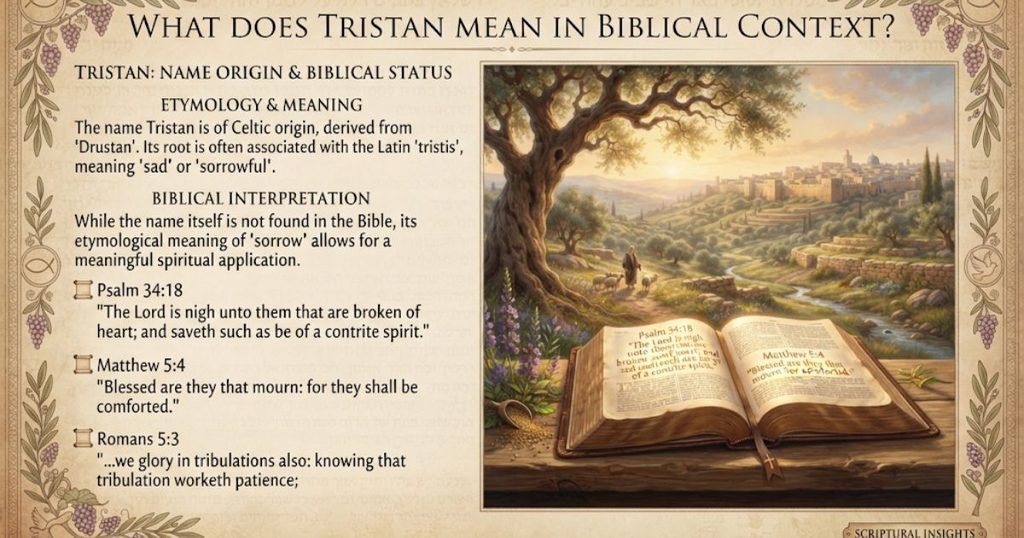
The first thing to understand about the Tristan meaning Bible question is that Scripture does not provide a direct definition for Tristan. The name does not appear among the personal names recorded in the Old Testament or New Testament. Contemporary references that specifically examine the biblical question likewise state that Tristan is not found in Scripture.
This means that calling Tristan a biblical name would be historically inaccurate. It is better described as a name from European linguistic and literary traditions that can later be given personal Christian significance.
Is Tristan a Biblical Name?
No. Tristan is not a biblical name in the strict historical sense.
There is no prophet, king, apostle, disciple, patriarch, judge, or other biblical character named Tristan. There is also no verse that says Tristan means a particular spiritual quality.
The distinction is important because modern baby name websites sometimes combine historical etymology with spiritual interpretation. Those are two different things.
A name can have Christian significance without originating in Scripture. Many families use names from cultures outside the biblical world while connecting those names with values such as faith, courage, compassion, wisdom, or hope.
What Does Tristan Mean Spiritually?
There is no single official spiritual meaning of Tristan established by the Bible.
The name has acquired several associations through its linguistic and literary history. Its connection with Old French triste, meaning sad, contributed to the familiar interpretation of Tristan as sorrowful or sad. At the same time, its older connection with Drust or Drustan has been associated by some sources with ideas such as tumult or noise.
For Christian reflection, these associations can be compared with biblical themes surrounding suffering, perseverance, comfort, courage, and hope.
That is a symbolic application rather than a biblical translation.
Why Does the Bible Connection Matter?
People often search a name together with “Bible” because they want more than a dictionary definition. They may be choosing a baby name, researching their own name, or looking for spiritual symbolism.
A careful answer should therefore distinguish between:
• The historical origin of Tristan
• Its later literary associations
• Its absence from biblical texts
• Christian values that can be associated with it today
This approach avoids turning an interpretation into a supposed biblical fact.
Biblical Presence of the Name Tristan
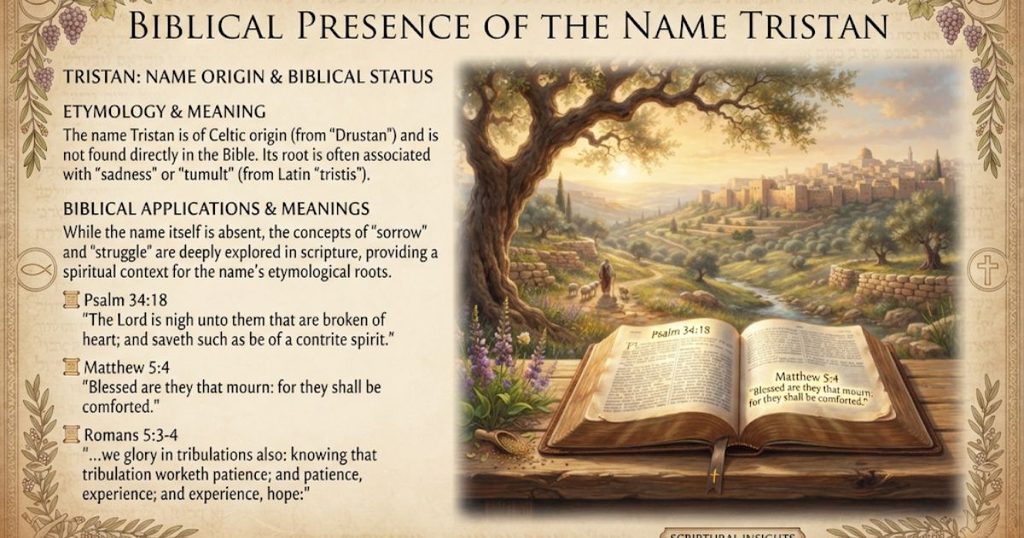
The question “Is Tristan in the Bible?” has a straightforward answer: Tristan does not appear as a biblical personal name.
This applies to both major divisions of Christian Scripture. The Old Testament contains Hebrew and related ancient Near Eastern naming traditions, while the New Testament contains many Jewish, Aramaic, Greek, and Roman names. Tristan belongs to a different European naming history.
Tristan in the Old Testament
There is no recorded Old Testament character named Tristan.
The Old Testament includes thousands of personal names, but Tristan is not among them. Its absence is consistent with the name’s later European development.
This means readers should not expect to find a Tristan in Genesis, Exodus, Psalms, Proverbs, Isaiah, or the historical books.
Tristan in the New Testament
Tristan is not recorded in the New Testament either.
The New Testament names people such as Jesus, Peter, Paul, John, James, Mary, Martha, and many others, but Tristan is not included.
Therefore, there is no New Testament passage that directly explains the name or assigns it a spiritual definition.
Is the Name Tristan in the Bible?
No. The name Tristan is not present in the biblical text.
This fact does not prevent a Christian from using the name. It simply means that its significance should not be presented as if it came directly from Scripture.
| Question | Answer |
| Is Tristan in the Bible? | No |
| Is Tristan a Hebrew biblical name? | No established evidence |
| Is Tristan a Greek biblical name? | No established evidence |
| Is Tristan connected with Pictish naming? | Yes |
| Is Tristan connected with Welsh forms? | Yes |
| Is Tristan associated with medieval literature? | Yes |
| Can Christians use Tristan? | Yes |
The table shows why historical origin and spiritual use should be discussed separately.
Linguistic Roots and Spiritual Connections
The linguistic history of Tristan is more complex than the simple definition “sad.”
Behind the Name identifies Tristan as probably coming from the old Pictish name Drustan, described as a diminutive of Drust. It also notes that the Tristan form appears in 12th century French tales and may have been influenced by Old French triste, meaning sad. Welsh forms include Trystan and Drystan.
The Older Drust and Drustan Forms
Drust and Drustan are important when investigating the history of Tristan.
Some modern etymological discussions connect Drust with an old Celtic element associated with tumult or noise, although the precise original meaning is not completely certain. Current name references therefore avoid presenting one disputed meaning as absolute fact.
This uncertainty is normal in historical name research. Names can survive for centuries while their original meanings become difficult to reconstruct.
Welsh Forms of Tristan
Trystan and Drystan are Welsh forms associated with Tristan.
These forms demonstrate how names can change as they move between languages and cultures. Tristan should therefore not be forced into a Hebrew or Greek etymology simply because someone is researching it from a Christian perspective.
The Welsh connection also helps explain why Tristan is frequently described as having Celtic or Welsh associations.
The French Influence
The later French form played a major role in the name’s association with sadness.
Medieval writers connected Tristan with the Old French word triste, meaning sad. This association suited the tragic story surrounding Tristan and Iseult, making the “sad” interpretation especially memorable.
It is more accurate to say that sadness became a literary and linguistic association than to claim that sadness was unquestionably the original meaning.
Scriptural Themes Reflecting Tristan’s Essence
Although Tristan is not a biblical name, several qualities associated with its history can be considered alongside Scripture.
These connections are thematic rather than etymological.
Perseverance Through Hardship
The Bible frequently presents perseverance as an important part of spiritual life.
James 1:2 to 4 connects trials with perseverance and maturity. Romans 5:3 to 5 similarly discusses suffering, perseverance, character, and hope.
For someone who connects Tristan with sorrow or hardship, these passages provide a meaningful Christian perspective.
The lesson is not that Tristan literally means perseverance. Instead, a person named Tristan can choose perseverance as a value.
Hope After Sorrow
The sadness associated with Tristan provides an opportunity to reflect on biblical hope.
Psalm 30:5 presents sorrow as temporary in comparison with joy. Romans 15:13 describes God as the source of hope.
This creates a powerful devotional contrast: sorrow may be part of life, but Scripture does not present sorrow as the final destination.
Courage During Difficult Seasons
Courage is another theme that can be associated with the name’s literary image.
Joshua 1:9 encourages courage and trust in God’s presence. The biblical idea of courage is grounded in faith rather than personal strength alone.
A Christian interpretation of Tristan can therefore emphasize courageous faith while acknowledging that courage is not the historical definition of the name.
Compassion for Others
The association with sadness can also encourage reflection on compassion.
Romans 12:15 teaches believers to rejoice with those who rejoice and mourn with those who mourn. This creates a useful spiritual connection for someone who sees emotional depth as part of the name’s symbolism.
Compassion is a biblical value that stands independently from Tristan’s etymology.
Tristan Meaning in Greek: What Is Known?
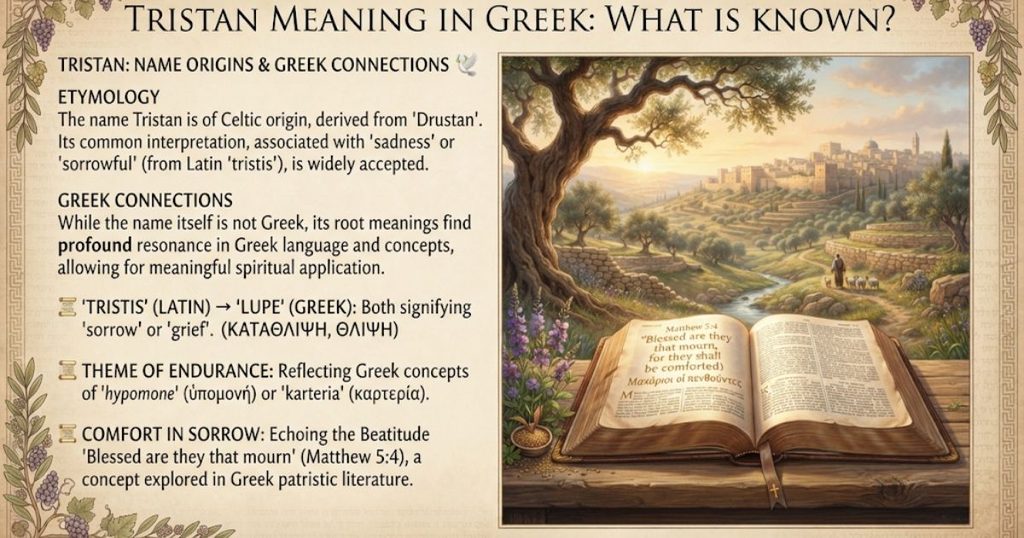
The question “What does Tristan mean in Greek?” is common, but there is no established Greek origin for the name.
Tristan is generally discussed in connection with Pictish, Welsh, Celtic, and medieval French traditions rather than Ancient Greek.
Does Tristan Have a Greek Meaning?
There is no well established original Greek meaning of Tristan.
A name can be transliterated into Greek letters, but writing a foreign name in Greek does not make the name Greek in origin.
This distinction is particularly important for Bible research because the New Testament was written largely in Koine Greek. A name’s appearance in a Greek text and a name’s Greek etymology are not the same thing.
Is Tristan a Greek Biblical Name?
No.
There is no established evidence that Tristan originated as a Greek biblical name.
Its historical development points toward older European naming traditions. Therefore, claims that Tristan directly means a specific Greek biblical concept should be treated cautiously unless supported by reliable linguistic evidence.
Why Is a Greek Meaning Sometimes Suggested?
Many Christian name searches focus on Hebrew and Greek because those languages are strongly associated with biblical texts.
However, not every Christian name is Hebrew or Greek. Christian communities have adopted names from numerous languages throughout history.
Tristan is a useful example of why historical name research should begin with etymology rather than assuming that every name has a biblical language origin.
The Medieval Story Behind Tristan
The name became internationally recognizable largely through medieval European literature.
Tristan is one of the central figures in the famous Tristan and Iseult romance. The story developed in medieval literature and later became connected with the broader Arthurian tradition.
Tristan and Iseult
The traditional story centers on Tristan, Iseult, and King Mark.
One important version describes Tristan being sent to bring Iseult to King Mark, after which a love potion contributes to the tragic relationship between Tristan and Iseult.
The story is literary legend, not biblical history.
Its importance to the name is that it helped reinforce associations with love, tragedy, loyalty, conflict, and sorrow.
Tristan and Arthurian Tradition
Later traditions connect Tristan with King Arthur and the Knights of the Round Table.
This explains why Tristan sometimes appears in discussions of Arthurian names rather than biblical names.
The Arthurian connection also demonstrates why the name can feel familiar in Christian cultures while still having no direct biblical origin.
Why the Literary Story Matters
A name’s cultural meaning can develop through famous stories.
Tristan’s modern emotional associations cannot be understood fully without considering the medieval literature that popularized the name.
The literary tradition helped make the sadness association particularly strong because the central story is tragic.
Symbolic Spiritual Meanings
Modern Christian readers sometimes want a symbolic meaning even when a name is not found in Scripture.
For Tristan, several themes can be used carefully without presenting them as official biblical definitions.
Strength Through Trials
The first theme is endurance.
A person can experience difficulty without allowing hardship to determine their identity. Biblical passages about perseverance provide a foundation for this idea.
This can make Tristan a personal reminder that difficult seasons can be met with faith.
Faith During Uncertainty
Another theme is trust.
Proverbs 3:5 to 6 encourages trust in God rather than relying entirely on personal understanding.
This theme can be connected with the broader idea of remaining faithful when life does not make immediate sense.
Emotional Depth
Because Tristan has a long association with sorrow and tragic romance, emotional depth is another modern symbolic interpretation.
Christian faith does not require people to pretend that pain does not exist. Scripture contains prayers of grief, lament, hope, gratitude, and trust.
This makes emotional honesty compatible with a mature spiritual life.
Hope and Restoration
Hope provides another positive Christian association.
Romans 15:13 presents hope as something connected with God and the work of the Holy Spirit.
For someone who associates Tristan with sorrow, this creates a meaningful contrast between hardship and restoration.
A Name of Christian Significance?
Tristan is not biblical by origin, but it can still be meaningful to Christians.
Christian naming practices have never been limited to names that appear in Scripture. Families have historically used names from different languages and cultures.
Can Christians Use the Name Tristan?
Yes.
There is no requirement that every Christian name must be found in the Bible.
A family may choose Tristan because of its sound, heritage, cultural history, family preference, or personal symbolism.
If parents specifically want a name that appears in Scripture, however, Tristan would not meet that particular requirement.
What Can Give Tristan Spiritual Meaning?
A Christian family can connect the name with values such as:
• Faith during difficult circumstances
• Courage when facing uncertainty
• Compassion for people experiencing pain
• Perseverance through challenges
• Hope after disappointment
• Wisdom in important decisions
• Integrity in relationships
These values come from Christian teaching, not from a direct definition of Tristan.
Contrasting Legend With Scripture
One of the most important parts of researching Tristan is knowing where legend ends and Scripture begins.
The Tristan and Iseult story is medieval European literature. The Bible is a collection of sacred texts with its own historical, theological, and literary traditions.
The Tristan Legend Is Not Biblical History
Tristan should not be described as a biblical warrior, biblical prince, or biblical hero.
There is no biblical account of Tristan and Iseult.
The story belongs to medieval romance and later Arthurian traditions. Behind the Name specifically places Tristan within English, French, and Arthurian naming usage while tracing the name toward older Pictish roots.
Shared Themes Do Not Prove Shared Origins
A medieval story can contain themes that resemble biblical ideas without being based directly on Scripture.
For example, courage appears in both Arthurian stories and the Bible. Love appears in both medieval romance and Christian teaching. Suffering appears in both literature and Scripture.
Similarity of theme does not prove that the name or story originated in the Bible.
Why This Distinction Builds Trust
Accurate name research should tell readers when evidence is certain and when an interpretation is uncertain.
For Tristan, the strongest historical evidence concerns its European linguistic and literary development. Its Christian meaning is interpretive rather than directly stated by Scripture.
That distinction makes the explanation more useful for readers researching a baby name or their own identity.
Tristen Name Meaning Bible
The spelling Tristen is a modern variant of Tristan.
Behind the Name lists Tristen as a modern English variant and notes that it can be used for both males and females in contemporary usage.
Is Tristen in the Bible?
No.
Changing Tristan to Tristen does not create a biblical origin.
The same basic historical distinction applies: the form belongs to modern naming usage connected with Tristan rather than being a name recorded in Scripture.
Does Tristen Have the Same Spiritual Associations?
Modern users may give Tristen the same symbolic associations as Tristan because it is a variant spelling.
Those associations can include perseverance, hope, courage, compassion, and emotional depth.
Again, these are spiritual reflections rather than biblical definitions.
What Does the Name Tristan Mean in Prayer?
There is no biblical prayer that assigns a special meaning to Tristan.
However, someone named Tristan can certainly be prayed for using biblical themes.
A Simple Prayer for Tristan
A Christian prayer for Tristan might ask God for wisdom, courage, protection, compassion, peace, and strength.
The prayer can be grounded in Scripture rather than in an invented definition of the name.
For example, Proverbs 3:5 to 6 can inspire a prayer for guidance, while Joshua 1:9 can inspire a prayer for courage.
Bible Themes for Praying Over Tristan
Useful themes include:
• Wisdom from James 1:5
• Courage from Joshua 1:9
• Peace from Philippians 4:6 to 7
• Hope from Romans 15:13
• Strength from Isaiah 41:10
• Guidance from Proverbs 3:5 to 6
These passages provide genuine biblical foundations for prayer.
Tristan Name Meaning Bible for Christian Baby Names
Parents researching Tristan name meaning Bible may be trying to determine whether the name fits their faith.
The answer depends on what they expect from a name.
If You Want a Direct Biblical Name
Tristan would not fit the requirement because it is not found in Scripture.
Parents looking specifically for biblical names can instead research names with documented Hebrew, Aramaic, Greek, or biblical origins.
If You Want a Meaningful Christian Name
Tristan can still be used.
A Christian family may connect the name with values they hope their child will embody. The important thing is to describe the name’s history accurately.
For example, parents might say:
“Tristan is a European name with an old Pictish and Welsh history. We connect it personally with courage, perseverance, and hope.”
That is a personal spiritual interpretation rather than a false claim that Tristan is a biblical word.
Tristan Meaning Bible and Personal Identity
Names often become part of how people understand their identity.
For someone named Tristan, discovering that the name is not biblical does not make the name meaningless.
Historical Meaning Is Only One Part
A name can carry several layers:
| Layer | Tristan |
| Historical | Connected with older European forms |
| Linguistic | Probably related to Drust or Drustan |
| Medieval | Popularized through Tristan and Iseult |
| Literary | Associated with love, tragedy, and courage |
| Biblical | Not directly present in Scripture |
| Spiritual | Can be connected symbolically with Christian values |
| Personal | Can receive meaning through family and individual experience |
This layered approach provides a more accurate understanding than assigning one simple definition.
Names Do Not Determine Character
A person’s name does not guarantee their personality, future, or spiritual condition.
Someone named Tristan is not destined to experience sorrow simply because the name developed an association with the French word triste.
Likewise, a person does not automatically become courageous because their name is associated with a heroic literary character.
Character develops through choices, relationships, circumstances, beliefs, and actions.
Why the Tristan Meaning Bible Search Is So Popular
Searches for what does the name Tristan mean in the Bible often combine three separate interests: name meaning, religious identity, and personal symbolism.
Parents Want Meaningful Names
Parents frequently research the background of a name before choosing it.
They may want to understand its language, history, cultural associations, and potential spiritual interpretation.
For Christian parents, Scripture may be one of the first places they look.
People Research Their Own Names
Adults also search name meanings because they want to understand where their names came from.
A person named Tristan may discover that the name has multiple layers of history, including Pictish, Welsh, French, and Arthurian associations.
The Internet Blends Different Traditions
Online name content can sometimes combine etymology, mythology, religion, numerology, personality descriptions, and modern spirituality.
These categories should not automatically be treated as equally reliable.
For biblical research, it is especially important to distinguish what Scripture actually says from later interpretations.
What Does Tristan Mean in the Bible for Modern Christians?
The most accurate answer remains that Scripture does not assign Tristan a meaning.
However, modern Christians can still reflect on the name through biblical principles.
A Faith Based Interpretation
One possible interpretation is that the name can remind a person that difficult experiences do not have to define their future.
Sorrow can be met with hope. Fear can be met with faith. Hardship can be met with perseverance. Uncertainty can be met with prayer.
These are biblical ideas, even though they are not the etymology of Tristan.
A Balanced Spiritual Message
A balanced Christian message about Tristan could be summarized this way:
Tristan is not a biblical name, but its history provides themes that can be thoughtfully compared with Scripture. Its association with sorrow can remind believers of biblical comfort and hope, while its literary connection with courage can encourage reflection on faith and perseverance.
This approach respects both historical research and Christian belief.
Biblical Values That Can Be Connected With Tristan
The following values are not literal meanings of the name, but they offer useful devotional connections.
Hope
Hope is central to Christian teaching.
Romans 15:13 provides a particularly relevant passage because it connects believers with hope through faith.
Courage
Joshua 1:9 is a familiar biblical passage about courage and God’s presence.
This can provide a strong devotional theme for anyone who wants Tristan to symbolize bravery.
Perseverance
James 1:2 to 4 presents perseverance as something developed through trials.
This theme works naturally with the name’s long literary association with hardship.
Compassion
Romans 12:15 encourages believers to share the emotional experiences of others.
This offers a positive way to interpret the name’s association with sorrow without suggesting that sadness defines the person.
Faith
Hebrews 11 emphasizes the importance of faith.
A person named Tristan can choose faith as a central value regardless of the name’s linguistic origin.
How to Explain Tristan Meaning Bible to a Child
Children may eventually ask why they were given their name.
If the child is named Tristan, the explanation does not need to be complicated.
A Simple Explanation
You could say:
“Tristan is an old European name. It is not a name found in the Bible, but we can connect your life with Bible values such as courage, kindness, faith, and hope.”
This explanation is honest while still giving the child a positive spiritual framework.
Why Honesty Matters
Children benefit from learning the difference between history and interpretation.
Instead of saying that the Bible defines Tristan as “strong” or “sorrowful,” parents can explain that those are associations found in name history and literature.
Then they can point to actual Bible passages that teach courage, faith, kindness, and hope.
Is Tristan Suitable for Both Boys and Girls?
Tristan has traditionally been used primarily as a masculine name.
However, modern naming practices can vary between cultures and communities. Behind the Name lists Tristan as masculine in its English and French usage while also identifying Tristen and Tristin as modern forms that may be used for more than one gender.
Traditional Usage
The best known literary Tristan is male, and the traditional use of the name reflects that history.
Modern Variations
Forms such as Tristen, Tristin, and Triston are used in contemporary naming.
Therefore, the choice of spelling and usage can depend on family preference, cultural context, and local naming traditions.
Key Facts About Tristan Meaning Bible
| Topic | Accurate explanation |
| Biblical appearance | Tristan is not recorded in Scripture |
| Old Testament connection | None established |
| New Testament connection | None established |
| Hebrew origin | Not established |
| Greek origin | Not established |
| Pictish connection | Strongly associated with Drust and Drustan |
| Welsh connection | Trystan and Drystan |
| French influence | Associated with triste, meaning sad |
| Medieval connection | Tristan and Iseult romance |
| Arthurian connection | Yes |
| Direct biblical meaning | None |
| Christian use | Possible |
| Spiritual interpretation | Personal and thematic |
This summary helps answer the main search questions without confusing historical evidence with modern devotional interpretation.
Frequently Asked Questions
What is Tristan meaning Bible and its spiritual significance?
Tristan is not found in the Bible, so Scripture gives it no direct meaning. Christian readers may symbolically connect it with hope, courage, perseverance, and compassion.
Is Tristan meaning Bible connected to any biblical characters?
No. There is no biblical character named Tristan in either the Old Testament or New Testament.
Does Tristan meaning Bible have a Hebrew or Greek origin?
No established Hebrew or Greek origin is documented. The name is generally connected with Pictish, Welsh, Celtic, and medieval European traditions.
Why do people search for Tristan Meaning in Bible today?
People commonly search it when researching baby names, personal identity, Christian symbolism, or the difference between historical name meanings and biblical meanings.
Can Tristan meaning Bible be used for Christian baby names?
Yes. Tristan is not biblical by origin, but Christian families can use names from different cultures and connect them with personal faith and values.
How does Tristan Meaning in Bible relate to faith and courage?
The Bible does not define Tristan as courageous, but courage and faith are biblical themes that can be personally associated with the name.
Is Tristan Meaning in Bible suitable for both boys and girls?
Tristan has traditionally been masculine, while modern variants such as Tristen and Tristin may be used more broadly.
What Bible values connect with Tristan meaning Bible?
Hope, perseverance, courage, compassion, wisdom, faith, and trust in God can provide meaningful Christian themes for personal reflection.
Does Tristan Meaning in Bible represent strength in hard times?
Not as a literal biblical definition. However, perseverance and strength during hardship are biblical themes that can provide a meaningful spiritual interpretation.
Conclusion
The clearest answer to Tristan meaning Bible is that Tristan does not have a direct biblical definition because the name does not appear in Scripture. 📖Its documented history points instead toward older Pictish and Welsh forms, followed by medieval French and Arthurian literary development.
The association with sadness developed partly through the French triste connection and the tragic Tristan and Iseult tradition. For Christians, the name can still carry personal spiritual symbolism when connected with biblical values such as faith, courage, perseverance, compassion, and hope.
✨These spiritual associations should be presented as reflection rather than as meanings officially assigned by the Bible. Understanding this distinction gives readers a more accurate and trustworthy answer while still allowing Tristan to carry personal and meaningful significance.
