
Tristan Meaning in Bible often raises questions for people who want to understand the name beyond popularity. The name is not found in Scripture, yet its history offers connections with sorrow, courage, loyalty, and perseverance. Understanding those connections requires separating historical etymology from spiritual interpretation.
Tristan is generally linked to the Pictish name Drustan and the name Drust, while medieval French tradition associated Tristan with triste, meaning sad. That history explains why Christian discussions connect the name with sorrow and emotional depth.
This guide examines its biblical status, linguistic roots, spiritual symbolism, Greek and Hebrew questions, Christian use, related names, and Scripture themes without presenting interpretations as direct biblical definitions.
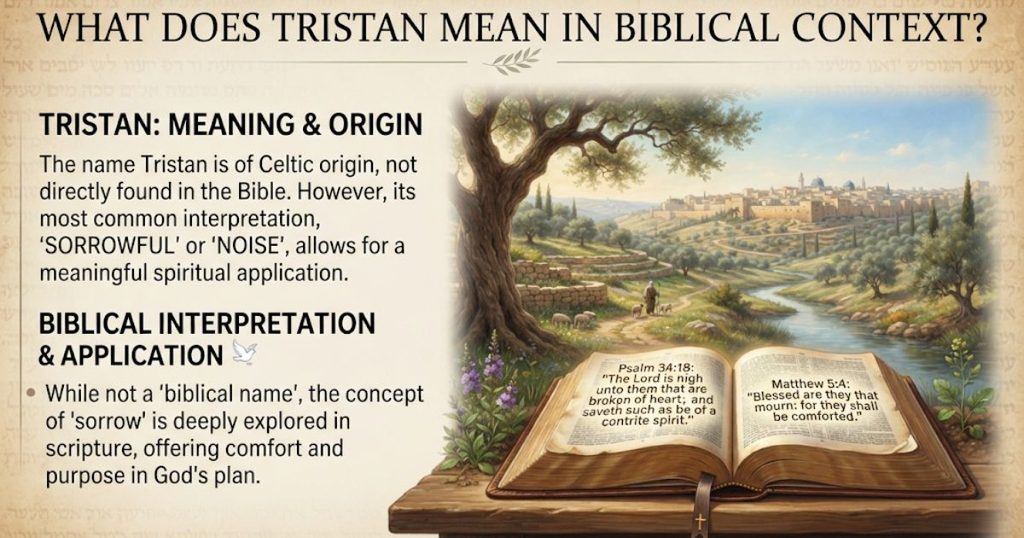
What Does Tristan Mean in Biblical Context?
The direct answer
The clearest answer is that Tristan is not a biblical name and does not have a definition assigned to it by Scripture. It does not appear as the name of a prophet, king, disciple, apostle, or other biblical figure.
This distinction matters because many online explanations describe Tristan as though the Bible itself gives the name a meaning such as sorrow, sadness, strength, or courage. Those descriptions are better understood as spiritual interpretations rather than direct biblical definitions.
The historical evidence points toward a Pictish origin connected with Drustan and Drust. Behind the Name identifies Tristan as probably developing from the old Pictish name Drustan, a diminutive of Drust. It also explains that the medieval form Tristan was influenced by the Old French word triste, meaning sad.
Therefore, there are two different questions:
| Question | Accurate answer |
| Is Tristan found in the Bible? | No |
| Does Scripture define Tristan? | No |
| Is Tristan connected with biblical themes? | Yes, through interpretation |
| Is Tristan traditionally linked with sadness? | Yes, partly through medieval French association |
| Is Tristan connected with Pictish naming history? | Yes |
| Is Tristan originally a Hebrew name? | No |
| Is Tristan originally a Greek name? | No |
What the Bible does and does not say
The Bible contains many names whose meanings are explained within Hebrew, Aramaic, or Greek contexts. Tristan belongs to a different naming tradition.
This means a responsible explanation should not create a fake biblical translation. Instead, the historical meaning should be presented first, followed by themes that Scripture discusses.
For example, the Bible repeatedly addresses grief, endurance, comfort, courage, compassion, faith, and hope. These subjects can provide a meaningful spiritual framework for someone who likes the name Tristan.
The difference is important. Saying “Tristan means courage in the Bible” suggests that Scripture directly defines the name that way. Saying “the history and symbolism associated with Tristan can be reflected through biblical ideas about courage” is much more accurate.
For readers researching a name for a baby, social profile, character, or personal reflection, this distinction makes the information more trustworthy.
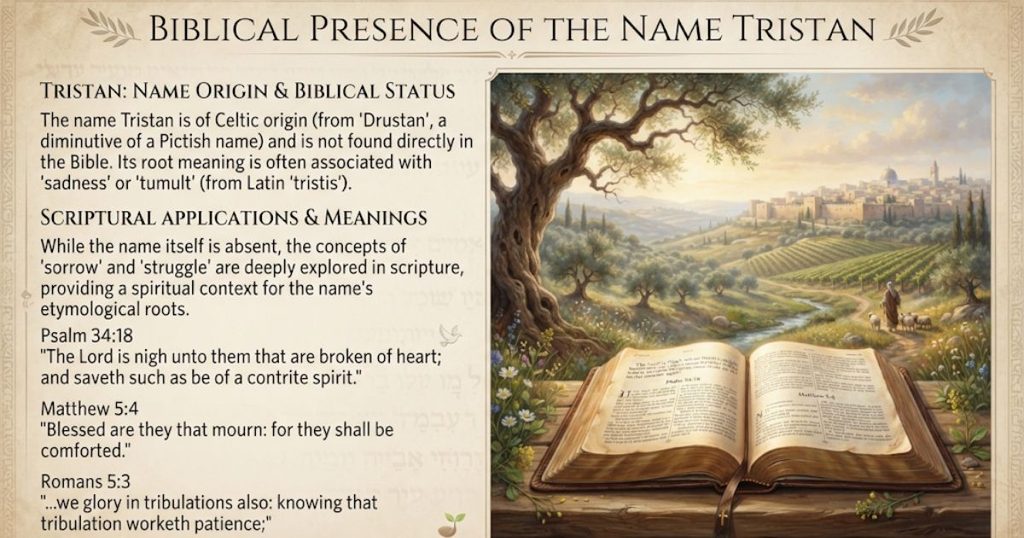
Biblical Presence of the Name Tristan
Is Tristan in the Old or New Testament?
Tristan does not appear as a personal name in the Old Testament or New Testament. There is no biblical character named Tristan.
The name developed through European naming traditions rather than through the biblical naming systems of ancient Israel or the early Christian world. Behind the Name connects it with Pictish Drustan and medieval Arthurian tradition, where Tristan became prominent in French tales during the twelfth century.
This also answers the common search query, “is the name Tristan in the Bible?” The answer is no.
That does not make the name meaningless. It simply places Tristan in the category of a nonbiblical name that may still be used by people of Christian faith.
Why nonbiblical names can still be used by Christians
A Christian family does not have to choose a name that appears word for word in Scripture. Many names used by Christians today developed through cultures, languages, and historical traditions outside the Bible.
The important question is often what the name represents to the family.
Parents may value Tristan because of its sound, heritage, historical associations, family connection, or the qualities they associate with it. They can also connect those qualities with biblical principles without claiming that the Bible originally assigned those qualities to the name.
For example, a family might connect the name with perseverance during difficult seasons. Scripture contains many teachings about remaining faithful through trials.
Another family may focus on compassion because the name has become associated with emotional depth and sorrow. Biblical teachings about caring for people who suffer provide a natural spiritual connection.
This approach keeps the name historically accurate while still allowing personal faith to give it significance.
Linguistic Roots and Spiritual Connections
Drust, Drustan, and Trystan
The history of Tristan is more complex than a simple one word translation.
Behind the Name states that Tristan probably comes from the Pictish name Drustan, which itself is a diminutive of Drust. Its related names include Drystan and Trystan in Welsh, as well as Tristen, Tristin, and Triston in English.
The separate entry for Drust connects that Pictish name with an old Celtic root associated with noise or tumult.
This gives the name a linguistic history that is different from simply saying “Tristan means sadness.”
The name became especially complicated because medieval French storytelling associated Tristan with the Old French word triste, meaning sad. According to Behind the Name, this association probably influenced the form and later perception of the name.
The French “triste” connection
The sadness association is one of the most widely discussed aspects of Tristan.
However, it should not be treated as proof that Tristan directly comes from a Latin word meaning sad. Some modern articles make that claim too confidently. The more careful historical explanation is that the name probably has an older Pictish connection and was later influenced by the similarity between Tristan and Old French triste.
This distinction gives readers a clearer picture of the name.
The word association with sadness became particularly powerful because of the medieval Tristan and Isolde story. Their legendary relationship became one of the best known tragic romances in medieval European literature.
So when people search for “Tristan meaning Bible,” they may encounter several layers at once:
• Pictish naming history
• Celtic linguistic connections
• Welsh forms such as Trystan
• Medieval French association with triste
• Arthurian romance
• Modern spiritual interpretations
These layers should not be treated as though they all originated in Scripture.
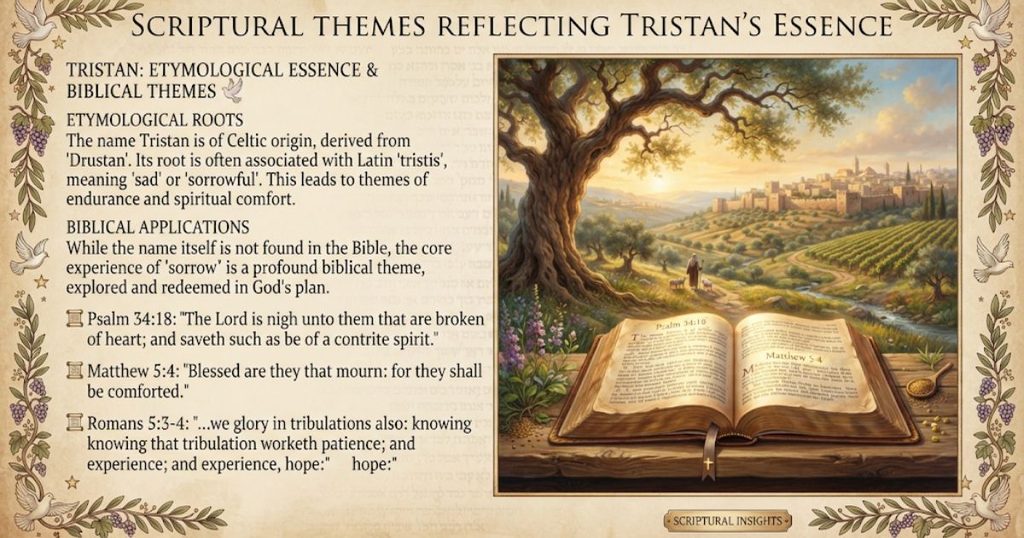
Scriptural Themes Reflecting Tristan’s Essence
Sorrow and comfort
Sorrow is one of the strongest biblical themes that can be connected symbolically with the history of Tristan.
Psalm 34:18 describes God as being near to people who are brokenhearted. This does not define Tristan, but it offers a meaningful biblical framework for understanding why sorrow does not have to represent hopelessness.
The Christian message repeatedly moves from suffering toward comfort, restoration, endurance, and hope.
That makes the sadness association more nuanced than it may first appear.
A person named Tristan does not need to interpret the name as a prediction of a sorrowful life. Instead, the association can remind someone that difficult emotions are part of human experience and that compassion matters when people face them.
Courage and perseverance
Another useful biblical connection is perseverance.
Romans 5:3 to 5 presents suffering as something that can produce endurance, character, and hope. James 1:2 to 4 similarly discusses perseverance during trials.
These passages do not mention Tristan. Their relevance comes from the qualities that modern readers may associate with the name.
This can create a thoughtful spiritual interpretation:
Sorrow can develop empathy.
Difficulty can teach perseverance.
Perseverance can strengthen character.
Character can support hope.
That progression is more consistent with biblical teaching than simply claiming that Tristan has a secret biblical definition.
Shayari for Wife in English
Although this topic sometimes appears beside searches for romantic names and meanings, shayari for wife in English belongs to a different search intent from the biblical study of Tristan.
If someone is researching Tristan for a romantic social media post, the emotional history of the name may make it appealing for poetic writing. The medieval Tristan and Isolde tradition also gives the name a strong literary connection with love, longing, devotion, and tragedy.
For a modern audience, however, romantic writing should not be confused with biblical interpretation.
A thoughtful caption about a wife could focus on gratitude, companionship, loyalty, or prayer. Those themes can complement a Christian relationship without claiming that Tristan itself is a biblical romantic term.
The distinction is especially useful for social media users who encounter names through captions, usernames, profile bios, or relationship content.
Beautiful Shayari for Girl
Beautiful shayari for girl searches may overlap with Tristan because Tristan is often encountered through literature, romance, and emotional storytelling.
The historical story of Tristan and Isolde helped shape the emotional reputation of the name. Behind the Name notes that Tristan appears in medieval French tales and later became connected with Arthurian tradition.
For modern users, this literary history can make Tristan feel poetic and expressive.
Still, there is a difference between literary symbolism and biblical symbolism.
Literary symbolism may focus on romance, longing, loyalty, tragedy, or devotion. Biblical symbolism may focus on faith, hope, compassion, perseverance, comfort, and trust in God.
Knowing which framework is being used prevents confusion when researching the name online.
Miss You Shayari 2 Line English
The phrase miss you shayari 2 line English represents another emotional use of the name’s broader cultural associations.
Tristan has long been connected with a tragic love story, so themes of separation and longing naturally appear around the name in literature and popular culture.
For a social media audience, the name can therefore carry an emotional tone even when the person using it knows nothing about its historical origin.
However, that emotional tone is not a biblical definition.
If someone connects Tristan with missing someone, that is a personal or literary association. It should not be presented as a hidden message from Scripture.
This distinction is particularly important when social media content mixes spirituality, names, relationships, and inspirational language.
2 Line True Love Miss You Shayari in English
True love and separation are major themes in the Tristan and Isolde legend, which helps explain why the name often appears in romantic discussions.
The story became influential in medieval European literature and helped shape the cultural identity attached to Tristan.
From a Christian perspective, however, romantic love can be discussed separately from the name’s biblical status.
Scripture contains teachings about love, faithfulness, kindness, patience, and selflessness. These principles can inspire relationship content without turning Tristan into a biblical romantic name.
For someone creating an Instagram caption, the historical and spiritual meanings can therefore be kept separate.
The name may suggest literary romance, while the caption can communicate personal values such as loyalty and sincere love.
Sad Shayari in English
The connection between Tristan and sadness is partly linguistic and partly literary.
The medieval French association with triste strengthened the sorrowful interpretation of the name, while the Tristan and Isolde story added an emotional and tragic dimension.
That history explains why sad poetry and Tristan searches can overlap.
Yet sadness itself is not presented in Scripture as a permanent identity. The Bible acknowledges grief while also repeatedly presenting comfort, endurance, restoration, and hope.
For Christian readers, this creates a more balanced interpretation.
A name with a sorrow related history does not have to symbolize a life controlled by sorrow. It can instead remind someone of empathy, emotional honesty, resilience, and the importance of hope during difficult moments.
Symbolic Spiritual Meanings
Strength through hardship
One possible spiritual interpretation of Tristan is strength developed through difficulty.
This does not come from a biblical definition of the name. It comes from placing the name’s sorrow related association beside biblical teachings about perseverance.
Romans 5:3 to 5 connects suffering with endurance, character, and hope. This makes the passage relevant when someone wants to give the name a faith centered interpretation.
The idea is not that hardship automatically makes someone strong. Rather, Scripture presents perseverance as something that can develop through faithful endurance.
For a person named Tristan, this can become a personal reminder to respond to challenges with patience, faith, and courage.
Compassion and emotional depth
Sorrow can also create a symbolic connection with compassion.
Someone who understands grief may become more attentive to the pain of others. This does not happen automatically, but it is a meaningful character ideal.
The Bible repeatedly calls believers toward mercy, kindness, patience, and care for people who are struggling.
That gives the emotional side of Tristan a constructive interpretation.
Instead of seeing sadness as weakness, a person can understand emotional depth as an opportunity to listen, support others, and show kindness.
Hope after sorrow
Hope is perhaps the most important balancing theme.
If Tristan is associated with sadness through medieval linguistic and literary history, a Christian interpretation does not have to stop there. Biblical teaching repeatedly presents hope as something that can exist during suffering.
Psalm 30:5 is commonly associated with the movement from weeping toward joy. Romans 8 discusses present suffering in the context of future hope.
These passages do not translate Tristan. They provide a biblical lens through which someone can reflect on the emotional associations attached to the name.
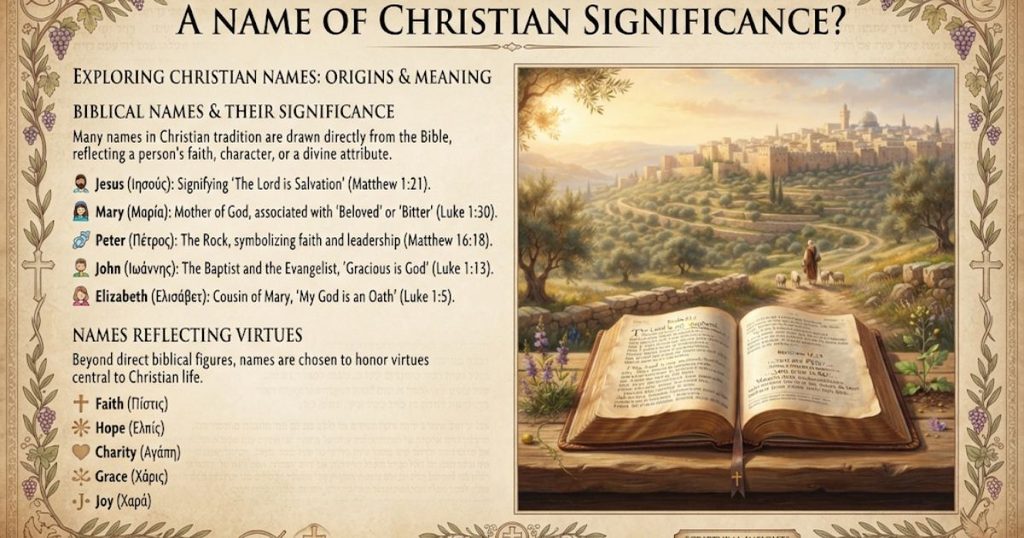
A Name of Christian Significance?
Biblical name versus Christian use
Tristan is not a biblical name in the historical sense.
A biblical name is one that appears within Scripture or comes directly from a biblical language and naming tradition. Tristan belongs to European linguistic and literary history instead.
A Christian name, however, can be understood more broadly as a name used by Christians or selected because a family finds its meaning, history, or symbolism compatible with its faith.
This makes it possible to use Tristan in a Christian family without claiming that it appears in the Bible.
Choosing meaning intentionally
Parents often give names additional significance through the values they hope the name will represent.
For Tristan, possible values include:
• Courage during difficult seasons
• Compassion toward people who suffer
• Loyalty in relationships
• Perseverance when life becomes difficult
• Hope after disappointment
• Emotional honesty balanced with faith
These are values rather than dictionary translations.
That distinction allows parents to create a meaningful family story around the name while remaining honest about its history.
Contrasting Legend with Scripture
Tristan and Isolde in medieval tradition
The Tristan and Isolde story is one of the central reasons the name became culturally recognizable.
According to the historical name record, Tristan first appears in twelfth century French tales. The story describes Tristan being sent by his uncle King Mark of Cornwall to bring Isolde to him. A love potion then becomes part of the tragic romance, and later versions connect Tristan with King Arthur’s knights.
This is medieval legend, not biblical history.
The distinction is essential because some online articles blend Arthurian storytelling with Christian symbolism until the boundary becomes unclear.
Why legend should not be treated as Scripture
The Bible and medieval romance have different origins, purposes, and historical contexts.
A story can influence the cultural meaning of a name without giving that name a biblical meaning.
The Tristan legend can help explain why people associate the name with romance, tragedy, loyalty, and longing. Scripture can help explain why Christians may connect those emotional experiences with themes of compassion, hope, perseverance, and faith.
Keeping the sources separate makes the final interpretation more accurate.
Tristan Meaning in Greek
Is Tristan a Greek name?
No established Greek etymology makes Tristan a Greek name.
The historical sources reviewed here connect Tristan with Pictish, Welsh, French, and Arthurian naming traditions rather than Greek. Behind the Name specifically identifies its usage as English, French, and Arthurian Cycle and traces it probably to Pictish Drustan.
Therefore, searches for “tristan meaning in greek” should not be answered with an invented Greek translation.
A Greek speaker could transliterate the name into Greek letters, but transliteration is not the same thing as etymology.
This is a common source of confusion online. A name can be written in another language without originating from that language.
Greek words with similar themes
Although Tristan is not Greek in origin, Greek biblical vocabulary can still help explain related ideas.
For example, the New Testament contains Greek terms associated with sorrow, suffering, endurance, joy, peace, and hope. These words describe biblical concepts, not the origin of Tristan.
That distinction allows readers to study the biblical themes without turning a thematic comparison into a false translation.
Tristen Name Meaning Bible
Tristen is commonly treated as a spelling variant of Tristan.
Behind the Name lists Tristen, Tristin, and Triston among English variants of Tristan, while Trystan and Drystan are associated with Welsh forms.
Therefore, when someone searches for “tristen name meaning bible,” the same central answer applies.
Tristen is not a name found in Scripture, and the Bible does not provide a special definition for that spelling.
Its spiritual interpretation can still follow the same themes associated with Tristan: perseverance, compassion, hope, courage, and emotional depth.
The spelling does not create a new biblical meaning.
What Does the Name Tristan Mean in the Prayer?
Can Tristan be included in a prayer?
Yes. A personal prayer can mention someone named Tristan just as it can mention any person.
Prayer does not require the person’s name to be biblical.
For example, someone could pray for Tristan to receive wisdom, protection, courage, peace, compassion, and strength. Those requests are based on biblical values rather than a supposed secret meaning of the name.
This is an important distinction for Christian readers.
The prayer gives the name personal spiritual significance, while Scripture provides the principles behind the prayer.
A simple prayer theme
A prayer for someone named Tristan could focus on:
• Wisdom when making important decisions
• Courage during uncertain seasons
• Peace during emotional difficulty
• Compassion toward others
• Strength during trials
• Hope when circumstances feel discouraging
• Faith that remains steady through change
These themes are suitable for personal prayer without claiming that Tristan itself is a biblical word.
What Does Tristan Mean in Greek?
The repeated search “what does Tristan mean in Greek” usually reflects confusion between translation and origin.
Tristan does not have a recognized Greek etymology. Its history is connected with older Pictish naming traditions, Welsh forms, and medieval French usage.
If Tristan is written using Greek letters, that is simply a representation of the name in another writing system.
A translation requires an equivalent word with a comparable meaning. A transliteration simply represents the sounds of a foreign name.
This difference is useful for anyone researching names online because search results often combine these two concepts.
Tristan in the Bible
Is there a biblical character named Tristan?
No.
There is no biblical character called Tristan in the Old Testament or New Testament.
This also means there is no recorded biblical story about a Tristan whose actions establish the name’s spiritual meaning.
The name’s cultural history comes from European sources rather than biblical narratives.
Why do people still connect Tristan with Scripture?
People often search for biblical meanings because names can feel deeply personal.
A parent may want a Christian interpretation for a baby name. A teenager may search the name because it appears in a username, relationship post, dream, or social media trend. Someone else may simply want to know whether the name has a biblical origin.
The answer can be both honest and useful: Tristan is not biblical, but its historical associations can be reflected through biblical themes.
Is the Name Tristan in the Bible?
No, the name Tristan is not recorded in Scripture.
This question deserves a direct answer because many search results make the subject more complicated than necessary.
The historical evidence instead points toward European naming traditions. Behind the Name connects Tristan with Pictish Drustan and notes its appearance in twelfth century French tales.
A useful way to remember the distinction is:
Biblical status: Not found in Scripture.
Historical origin: Probably Pictish, with later Welsh and French development.
Literary connection: Tristan and Isolde and Arthurian tradition.
Spiritual interpretation: Can be connected with biblical themes, but not defined by Scripture.
This framework answers the question without creating unsupported claims.
What Does the Name Tristan Mean in the Bible?
The phrase “what does the name Tristan mean in the Bible” needs a careful answer.
The Bible does not assign Tristan a meaning because Tristan is not a biblical name.
Historically, the name probably developed from Drustan, a diminutive of Drust. Later French association with triste contributed to the idea of sadness.
From a Christian perspective, readers may connect the sorrow association with biblical themes such as comfort, perseverance, compassion, and hope.
That interpretation is meaningful only when clearly presented as interpretation.
The strongest approach is therefore to separate three layers:
• Historical meaning and origin
• Medieval literary associations
• Modern spiritual interpretation
This prevents the common mistake of presenting a modern devotional explanation as though it were an ancient biblical definition.
Tristan Meaning in Bible
A balanced understanding of Tristan Meaning in Bible can be summarized through the relationship between history and faith.
Historically, Tristan is associated with Pictish Drustan and Drust, with later French influence from triste, meaning sad.
Biblically, the name itself is absent.
Spiritually, however, the name can remind a Christian reader of a meaningful biblical pattern: difficult experiences do not have to eliminate hope.
Sorrow can create an opportunity for compassion. Trials can develop endurance. Difficult seasons can encourage deeper dependence on God.
These ideas come from Scripture, not from the etymology of Tristan.
That distinction actually makes the interpretation stronger because it respects both historical evidence and biblical teaching.
What Does Tristan Mean in the Bible?
The answer can be expressed in one simple sentence:
Tristan has no direct biblical meaning, but its historical association with sadness can be thoughtfully connected with biblical themes of comfort, perseverance, courage, compassion, and hope.
This explanation is more reliable than claiming that Tristan literally means one specific spiritual quality.
The Bible does not tell readers that a person named Tristan will experience sorrow or possess a particular personality.
A name does not determine character.
Family environment, choices, relationships, experiences, beliefs, and personal growth all influence who a person becomes.
For social media users, this is especially important because name meaning posts often simplify complicated histories into one attractive phrase. A short definition can be useful, but it should not replace the fuller historical explanation.
Tristan Name Meaning Bible
The phrase “Tristan name meaning Bible” is popular because people want a direct answer that combines etymology and faith.
A responsible answer has four parts.
First, Tristan is not found in Scripture.
Second, its historical origin is generally connected with Pictish Drustan and Drust.
Third, medieval French association with triste helped create the sorrowful interpretation that became strongly connected with the name.
Fourth, Christians may interpret those associations through biblical ideas such as endurance, compassion, comfort, and hope.
This gives the name a meaningful spiritual perspective without inventing a biblical definition.
Positive Bible Verse Good Morning Blessings GIF
Searches for positive Bible verse good morning blessings GIFs may seem unrelated to Tristan, but they reveal how modern users often combine names, faith, images, and social media content.
A person named Tristan may receive a morning blessing that focuses on God’s guidance, peace, protection, wisdom, or strength.
Relevant biblical themes include:
• Psalm 118:24, which encourages gratitude for the day God has made
• Isaiah 41:10, which speaks about God’s presence and strength
• Psalm 23, which presents God as a shepherd and guide
• Proverbs 3:5 to 6, which encourages trust in God for direction
• Philippians 4:6 to 7, which connects prayer with peace
These verses do not define Tristan.
Instead, they provide faith based language that can be used in a prayer, greeting, caption, or personal reflection involving someone named Tristan.
For Gen Z social media users, this distinction is useful because inspirational content often blends several themes together. A meaningful post can still be accurate when its biblical references are kept separate from name etymology.
Biblical Values That Can Inspire the Name Tristan
Faith during difficult seasons
One of the strongest spiritual themes connected with the modern interpretation of Tristan is perseverance.
Faith does not mean pretending that difficult experiences do not hurt. Biblical stories include grief, disappointment, fear, loss, uncertainty, and waiting.
What makes these stories meaningful is the repeated movement toward trust and hope.
For someone who wants a Christian value attached to Tristan, perseverance can therefore become a thoughtful choice.
The name can serve as a reminder that a difficult chapter does not necessarily define the whole story.
Love, loyalty, and integrity
The Tristan and Isolde legend strongly influenced the cultural identity of the name through themes of love and loyalty. That literary association should remain separate from Scripture, but the values themselves can be discussed from a Christian perspective.
The New Testament contains teachings about love, patience, kindness, faithfulness, and self control.
A modern family might therefore associate Tristan with the desire to live faithfully and treat other people with dignity.
Again, this is a chosen value, not a dictionary definition.
How to Explain Tristan Meaning Bible in Simple Words
A short definition
If someone asks, “What does Tristan mean in the Bible?” a concise answer is:
Tristan is not a biblical name, so Scripture gives it no direct meaning. Its historical roots are linked with Pictish Drustan and Drust, while medieval French tradition associated it with sadness. Christians may connect those themes with biblical ideas of comfort, perseverance, compassion, and hope.
This version is short enough for a social media caption while remaining historically responsible.
A faith centered explanation
A longer explanation can say that Tristan represents a name whose cultural history includes sorrow and whose spiritual interpretation can point toward hope.
That does not mean a person named Tristan is destined to experience sadness.
Instead, it can become a symbolic reminder that people can face emotional pain while still practicing courage, compassion, patience, and faith.
For Gen Z audiences, this kind of explanation is more useful than a dramatic claim about a hidden biblical code.
Tristan, Tristen, Tristin, and Trystan: Are They the Same?
Common spelling variants
Tristan has several related forms.
| Name | Language or usage | Relationship |
| Tristan | English and French | Main modern form |
| Tristen | Modern English | Variant |
| Tristin | Modern English | Variant |
| Triston | English | Variant |
| Trystan | Welsh | Related form |
| Drystan | Welsh | Older related form |
| Tristram | British English | Medieval English form |
| Drustan | Pictish | Historical source form |
Behind the Name lists Tristen, Tristin, and Triston as variants and identifies Drystan and Trystan as Welsh forms.
How the variants differ
The spelling can vary by family preference, language, and cultural tradition.
Changing Tristan to Tristen does not create a new biblical meaning.
Likewise, Tristin does not suddenly become a Hebrew or Greek name.
The related forms belong to the same broad historical family, although individual forms have their own linguistic histories.
This is helpful for parents because baby name websites sometimes present spelling variations as completely different names. In this case, the relationship between the forms is well documented.
Why the Tristan Name Is Often Misunderstood Online
The problem with one word definitions
Name websites often prefer one short meaning because it is easy to display and remember.
Tristan is harder because its history includes several layers.
The Pictish Drust connection points toward one linguistic history, while the French triste association helped establish the sadness interpretation.
The medieval romance then added powerful literary associations.
Modern Christian websites sometimes add spiritual interpretations involving strength, faith, and hope.
None of these layers should automatically replace the others.
How to check a name meaning
When researching any name, look for:
• The earliest documented forms
• The language of origin
• Historical linguistic sources
• Variant spellings
• Whether the name actually appears in Scripture
• Whether a spiritual meaning is historical or interpretive
This approach is especially valuable for viral name meaning posts on social platforms, where simplified claims can spread quickly.
What Tristan Can Symbolize in a Modern Christian Family
A reminder of compassion
A family may choose to connect Tristan with compassion because of the name’s long association with sadness.
That can become a positive reminder to notice when other people are struggling.
Compassion is central to Christian ethics and appears throughout the teachings and example of Jesus.
The name therefore does not need to be biblical to inspire a biblical value.
A reminder of hope
Hope gives the sorrow association a second dimension.
If a name has become connected with sadness, a Christian family may intentionally emphasize what comes after sorrow: comfort, healing, endurance, and renewed hope.
This does not rewrite the name’s history.
It simply gives the family a meaningful way to understand it.
A reminder of courage
Courage is another useful symbolic theme.
Biblical courage is not the absence of fear. It often involves continuing to act faithfully while facing uncertainty.
That idea can give a person named Tristan a personal value to remember without pretending that courage is the literal meaning of the name.
Is Tristan Suitable for a Christian Baby Name?
What parents should consider
Yes, Tristan can be used by a Christian family as a personal naming choice.
The name is not biblical, but Christian families may use names from many linguistic and cultural traditions.
Parents considering Tristan may want to think about:
• The sound and spelling they prefer
• The historical origin of the name
• The medieval literary association
• The emotional meaning often attached to it
• The biblical values they want to emphasize
• How the full name sounds with the family surname
Meaning does not determine personality
A name should not be treated as a prediction of someone’s personality or future.
A child named Tristan is not destined to be sad because of the medieval association with triste.
Likewise, the name does not guarantee courage, loyalty, compassion, or spiritual strength.
Parents can give a name personal meaning, but a person’s character develops through life, relationships, choices, education, faith, and experience.
This is a healthier way to understand name symbolism.
Bible Verses That Reflect the Themes Associated With Tristan
Several biblical passages can be used when someone wants Scripture that reflects the themes often associated with Tristan.
| Theme | Bible reference | Main idea |
| Comfort | Psalm 34:18 | God is near to the brokenhearted |
| Courage | Joshua 1:9 | Be strong and courageous because God is with you |
| Endurance | Romans 5:3 to 5 | Trials can develop endurance and hope |
| Strength | Isaiah 41:10 | God promises help and strength |
| Hope | Romans 15:13 | God is described as the source of hope |
| Peace | Philippians 4:6 to 7 | Prayer is connected with God’s peace |
| Compassion | Colossians 3:12 | Believers are encouraged to practice compassion and kindness |
These verses do not establish a biblical meaning for Tristan.
They simply provide scriptural themes that can complement the symbolic interpretation of the name.
That distinction keeps the article faithful to both linguistic evidence and Scripture.
What Makes the Spiritual Interpretation Meaningful?
It connects history with values
The strongest spiritual interpretation does not invent an ancient biblical definition.
Instead, it begins with what is historically known and then asks what biblical values can help a modern Christian reflect on those associations.
For Tristan, the historical sadness association can lead to reflection on comfort.
The literary themes of loyalty can lead to reflection on faithfulness.
The broader emotional associations can lead to compassion.
The experience of difficulty can lead to perseverance and hope.
This approach creates a meaningful interpretation without pretending that the name was originally biblical.
It leaves room for personal faith
Different families may emphasize different values.
One person may connect Tristan with resilience.
Another may focus on compassion.
Someone else may appreciate the literary history.
A Christian family might focus primarily on hope and faith during difficult seasons.
There does not need to be one mandatory spiritual interpretation.
The important part is understanding which claims are historical and which are personal or devotional.
Frequently Asked Questions
What is Tristan Meaning in Bible and its spiritual significance?
Tristan is not found in Scripture, so it has no direct biblical definition. Its spiritual interpretation may connect its historical sadness association with comfort, perseverance, compassion, and hope.
Is Tristan Meaning in Bible connected to any biblical characters?
No. There is no biblical character named Tristan in the Old Testament or New Testament.
Does Tristan Meaning in Bible have a Hebrew or Greek origin?
No. Historical sources connect Tristan with Pictish, Welsh, and medieval French traditions rather than Hebrew or Greek.
Why do people search for Tristan Meaning in Bible today?
People commonly search it when choosing baby names, researching spirituality, exploring name origins, or looking for Christian interpretations of modern names.
Can Tristan Meaning in Bible be used for Christian baby names?
Yes. Tristan is not a biblical name, but a Christian family can choose it and attach personal values such as courage, compassion, faith, and hope.
How does Tristan Meaning in Bible relate to faith and courage?
The name itself does not mean faith or courage in Scripture. Those qualities can be used as modern spiritual themes alongside biblical teachings about perseverance.
Is Tristan Meaning in Bible suitable for both boys and girls?
Tristan is traditionally masculine in English and French usage, although modern naming practices can vary. Related forms and individual family preferences may differ.
Conclusion
Tristan has a fascinating history that reaches beyond a simple one word name meaning. Its roots are generally connected with Pictish Drustan and Drust, while medieval French tradition strengthened its association with sadness. The name does not appear in Scripture and has no direct Hebrew or Greek biblical definition.
Yet its themes can be thoughtfully connected with biblical ideas of comfort, perseverance, compassion, courage, and hope. For a Christian family, Tristan can therefore carry personal spiritual significance without being described as a biblical name. The most accurate approach is to respect its historical origin while allowing faith to give its symbolism personal meaning.
