
BMR is one of those health and fitness terms people see everywhere but often misunderstand. It appears in calorie calculators, fitness apps, diet plans, workout discussions, and social media posts, yet its actual meaning is quite specific.
The BMR meaning refers to basal metabolic rate, which is the energy your body needs to maintain essential functions while you are in a resting basal state. Your heart, breathing, circulation, temperature regulation, and other basic processes require energy even when you are not exercising.
Understanding BMR can make calorie and metabolism discussions much easier. It can also help you understand why two people with similar body weights may have different energy needs.
Why the Meaning of BMR Is Suddenly Confusing So Many People
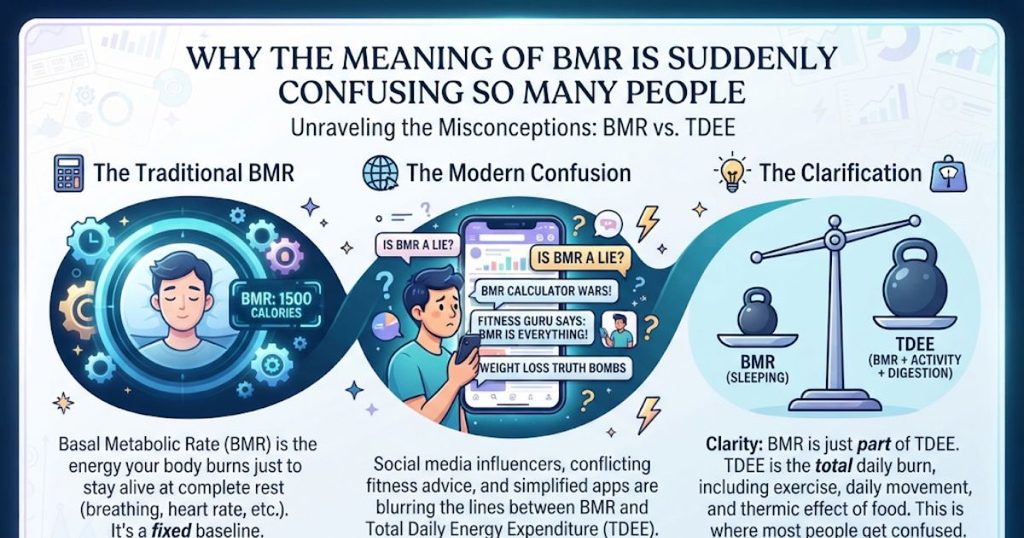
BMR is often treated online as if it means the total number of calories a person should eat each day. That is not what it means.
Your body uses energy for several reasons, including resting functions, physical activity, and processing food. BMR represents only the energy required for basic physiological functions under strict resting conditions.
What Does BMR Mean in Simple Terms?
In simple language, BMR is an estimate of how much energy your body needs just to keep its essential systems operating while you are at rest.
Think of it as the energy cost of staying alive, rather than the energy cost of your complete daily lifestyle.
Your BMR does not include all the calories you burn from walking, exercising, working, cleaning, shopping, or digesting meals.
What Is the Full Meaning of BMR in Health and Fitness?
BMR stands for Basal Metabolic Rate.
A true BMR measurement is taken under controlled conditions, including rest, fasting, and a thermally comfortable environment. In practical settings, people usually use equations to estimate it because laboratory measurement is not convenient for everyday use.
| Term | Meaning |
| BMR | Energy required for essential functions at basal rest |
| RMR | Energy required while resting under less strict conditions |
| TDEE | Total energy used across the entire day |
| TEF | Energy used to process and digest food |
| Activity energy | Calories used through movement and exercise |
The Hidden Truth Behind BMR That Most Health Advice Leaves Out
One reason BMR causes confusion is that it is sometimes presented as a fixed number. In reality, energy requirements differ from person to person.
Age, body size, body composition, sex, genetics, physiological state, and other factors can influence resting energy expenditure. Lean body mass is especially important when comparing metabolic rates between people.
What Does BMR Mean for Weight Loss or Weight Gain?
BMR is relevant to weight management because it forms part of your total daily energy expenditure.
However, your BMR alone does not determine whether you lose or gain weight. Physical activity, food intake, digestion, body composition, and other factors also contribute to daily energy balance.
What Is Body BMR and Why Is It Important?
Body BMR describes the estimated energy requirement associated with maintaining your body’s basic functions at rest.
It is useful as a starting point when estimating overall energy needs, but it should not be treated as a personalized prescription for how many calories you should eat.
How BMR Quietly Became Misunderstood and Sparked Online Arguments
Online fitness conversations often compare people by saying one person has a “fast” metabolism and another has a “slow” one. BMR can contribute to those differences, but it is only one part of the bigger picture.
A person with a higher BMR may use more energy at rest, while someone with a lower BMR may use less. That does not automatically mean either person has a healthy or unhealthy metabolism.
What Does BMR Mean in Calories Burned Per Day?
BMR is normally expressed as calories per day. It represents estimated energy expenditure under basal conditions.
For example, a calculator may estimate that someone has a BMR of 1,500 calories per day. This does not mean that 1,500 calories is automatically their recommended daily intake.
Daily energy needs are higher once movement, exercise, digestion, and other activities are considered.
What Is a Normal BMR Range for Adults?
There is no single normal BMR number that applies to every adult.
A person’s estimated BMR depends on characteristics such as age, body size, height, sex, and body composition. Two adults can therefore have different BMR values without either value being inherently abnormal.
What’s Causing People to Misread What BMR Really Means
The biggest mistake is treating BMR as a daily calorie target. Another common mistake is assuming that a lower number automatically means a damaged metabolism.
BMR is an estimate, not a complete diagnosis of metabolic health.
What Does Low BMR Mean for Metabolism?
A lower estimated BMR generally means the body is predicted to use less energy at rest than someone with a higher estimated rate.
It does not automatically prove that metabolism is unhealthy. Body size and composition can naturally influence energy expenditure.
What Does High BMR Mean and Is It Good?
A higher BMR means the body is estimated to require more energy at rest. This can occur because of differences in body size, lean mass, age, and other factors.
A high BMR is not automatically better, just as a low BMR is not automatically worse. Context matters.
BMR Meaning Is Trending Again and Fitness Experts Are Reacting
Searches about BMR often appear alongside questions about calorie intake, weight loss, metabolism, and fitness. This makes the term especially easy to misunderstand when short social media posts remove important context.
A calculator can provide a useful estimate, but the number should be interpreted alongside your overall lifestyle and goals.
What Does BMR Mean for Females Specifically?
The basic definition of BMR is the same for females and males. However, estimated values can differ because equations use factors such as body size, age, sex, and height.
The equation itself should not be interpreted as a judgment about health or fitness.
What Is the Meaning of BMR in Nutrition Science?
In nutrition science, BMR refers to energy expenditure required to maintain vital functions during a basal resting state.
Total daily energy expenditure includes additional components such as physical activity and the thermic effect of food.
What’s Happening Online That Made Everyone Question BMR
Short videos and fitness posts often turn complex nutrition concepts into simple statements. This can make BMR sound like a magic number that explains weight changes.
Real physiology is more complicated.
What Is the Difference Between BMR and TDEE?
BMR is the estimated energy required for essential functions under basal resting conditions.
TDEE, or total daily energy expenditure, represents energy used throughout the day and includes resting energy expenditure, physical activity, and the energy cost associated with processing food.
| Concept | What it tells you | Includes activity? |
| BMR | Basic energy needs at basal rest | No |
| RMR | Resting energy needs | No planned exercise |
| TDEE | Overall daily energy expenditure | Yes |
| TEF | Energy used to process food | Food processing only |
What Does Lower BMR Mean as You Age?
BMR can change as people age, partly because body composition and lean mass can change.
Age is only one factor. Body size, body composition, activity, health status, and other physiological factors also influence energy expenditure.
What Does BMR Mean for Your Body on a Normal Day
Your body does not stop using energy when you sit quietly. Vital systems continue working throughout the day.
The energy used for these basic processes is why BMR is an important part of understanding total energy expenditure.
How Does BMR Affect Daily Energy Needs?
BMR provides a foundation for estimating daily energy requirements. Your actual daily needs are higher because you move, eat, digest food, and perform routine activities.
This is why eating exactly your estimated BMR every day is not automatically appropriate.
Can BMR Change Over Time or With Lifestyle?
Yes. BMR can change as body weight, body composition, age, physiological state, and other factors change.
Lifestyle can affect the factors that contribute to energy expenditure, but claims about dramatically “boosting” BMR should be treated carefully.
Why BMR Can Mean Something Very Different Than You Think
The number produced by a calculator is an estimate. It should not be treated as a precise measurement of your metabolism.
Different equations can produce different estimates, and real energy expenditure can vary between individuals.
What Are Common Misunderstandings About BMR Meaning?
Common misunderstandings include:
• 🔥 Thinking BMR equals total daily calorie needs
• 📊 Assuming one BMR number defines metabolic health
• 🧮 Treating calculator results as exact measurements
• ⚖️ Assuming a high BMR automatically means better health
• 🍽️ Assuming eating below BMR is always appropriate or always harmful
• 🏃 Ignoring physical activity when estimating daily energy needs
The best interpretation is that BMR is one useful piece of a larger energy balance picture.
What Does BMR Mean in Slang, Business, and Industry?
In health and fitness discussions, BMR most commonly means Basal Metabolic Rate.
However, abbreviations can have different meanings in business, technology, organizations, and other industries. Context is therefore important when someone uses BMR outside a nutrition or fitness conversation.
BMR Calculator Explanation: Simple and Accurate
A BMR calculator usually asks for information such as age, sex, height, and body weight. Some calculators use established equations to estimate resting energy expenditure.
The result is an estimate rather than a direct laboratory measurement. Cleveland Clinic notes that equations can estimate BMR using characteristics such as sex, weight, height, and age.
What Information Does a BMR Calculator Use?
Most common BMR equations use several personal characteristics.
• 📏 Height
• ⚖️ Body weight
• 🎂 Age
• 👤 Sex
Some formulas use different variables or assumptions. This is one reason results from different calculators may not always match.
Example BMR Calculation
One commonly cited equation is the Harris Benedict equation. Cleveland Clinic provides the following estimates:
For males:
BMR = 88.362 + 13.397 × weight in kilograms + 4.799 × height in centimeters − 5.677 × age
For females:
BMR = 447.593 + 9.247 × weight in kilograms + 3.098 × height in centimeters − 4.330 × age
These equations provide estimates. They are not a substitute for individualized medical or nutrition assessment.
What Can Actually Help You Understand Your BMR Better?
Instead of focusing on whether your number is high or low, look at the bigger picture.
A useful interpretation considers your body size, goals, activity level, eating pattern, and changes over time.
For a more practical understanding:
• 🧮 Use the same type of calculator when comparing estimates
• 📈 Look at trends rather than obsessing over one number
• 🏃 Consider your activity level separately
• 🍽️ Remember that BMR is not your total calorie requirement
• 🩺 Discuss unusual concerns with a qualified healthcare professional
• 📚 Use established health information rather than viral claims
If your concern involves unexplained weight changes, persistent fatigue, symptoms of illness, or a suspected hormonal or metabolic condition, a healthcare professional can assess the situation properly.
BMR and Modern Fitness Culture
BMR has become a popular term because people want a simple explanation for calories and body weight. The problem is that a single number cannot explain every change in the body.
Fitness apps and online calculators can be useful educational tools. They become less useful when their estimates are treated as exact measurements or medical conclusions.
The most reliable approach is to use BMR as a starting estimate and then consider the rest of your daily energy expenditure.
Frequently Asked Questions
What does BMR stand for?
BMR stands for Basal Metabolic Rate. It describes the energy required to maintain essential bodily functions under basal resting conditions.
Is BMR the same as metabolism?
No. BMR is one measurement of resting energy expenditure, while metabolism refers to the broader collection of chemical processes occurring in the body.
Is it bad to eat below your BMR?
BMR is not a recommended daily intake target, so it should not be used alone to decide whether a calorie intake is appropriate.
Does a low BMR mean weight loss is impossible?
No. BMR is only one component of total energy expenditure and does not by itself determine whether weight loss can occur.
Can exercise increase BMR?
Exercise can influence body composition and energy expenditure, but changes in BMR are not simply determined by how much exercise you perform.
Why do people have different BMR values?
Differences in age, body size, body composition, sex, genetics, and physiological factors can contribute to different estimated or measured resting energy needs.
Is a high BMR always better?
No. A higher BMR simply means greater estimated energy expenditure at rest. It is not automatically a sign of better health.
Conclusion
Understanding the BMR meaning becomes much easier when you separate resting energy needs from total daily calorie expenditure. BMR describes the energy your body needs for essential functions while at rest.
It is influenced by several personal and physiological factors, so there is no universal number that is ideal for everyone. A calculator can provide a useful estimate, but it should not be treated as an exact measurement or a complete picture of your metabolism.
Use BMR as one piece of information rather than the entire answer. 🧮 Combine it with activity, nutrition, body composition, personal goals, and professional guidance when needed. Most importantly, do not let a single number create unnecessary confusion.
A clear understanding of BMR can help you make better sense of calorie and fitness information without turning an estimate into a rule.
