
Scroll through any comment section, group chat, or Twitter/X thread for more than a few minutes and you’ll eventually run into the letters “IDTS.” For newcomers to internet slang, it can look like a typo or a random keyboard mash. For regular texters, it’s second nature.
IDTS is one of those compact expressions that packs an entire sentence into four characters. It shows up when someone wants to push back on an idea, question a prediction, or gently signal “I’m not buying that” all without typing a full paragraph.
This guide breaks the term down completely: what it stands for, where it came from, how it’s actually used in real conversations, and where it can backfire if you use it in the wrong setting.
IDTS Meaning Quick Definition
IDTS is short for:
“I Don’t Think So.”
It’s an informal abbreviation people drop into texts, DMs, and comment threads to communicate:
- Mild disagreement
- Doubt about something being true
- Skepticism toward a claim or prediction
- A soft, non-confrontational “no”
Rather than spelling out the full phrase every time, users compress it into four letters quick to type, quick to read, and instantly understood by anyone familiar with texting culture.
Simple Examples
“Do you reckon the flight will get delayed?” “IDTS.”
“Think he’ll actually show up on time?” “IDTS, not with his track record.”
“We’ll wrap this up in twenty minutes.” “IDTS 😅”
Notice how the meaning barely changes across examples, but the feel shifts depending on punctuation, emojis, and the relationship between the people talking.
Origin & Background of IDTS
Abbreviated slang like IDTS didn’t appear overnight it grew out of necessity. Back when mobile phones had tiny number-pad keyboards and SMS messages were capped at a fixed character limit, typing out full sentences was slow and sometimes literally cost extra money per message. Shortening common phrases became second nature to frequent texters.
This is the same environment that gave rise to now-classic abbreviations such as:
- IDK – I don’t know
- IMO – In my opinion
- TBH – To be honest
- BRB – Be right back
IDTS slotted neatly into that same family. Instead of tapping out “I don’t think so” letter by letter on a cramped keypad, people condensed it down to a four-letter reply that got the point across just as clearly.
Why It Became Popular
A handful of cultural shifts helped IDTS spread far beyond its texting-app origins:
- The rise of fast-paced texting habits, where brevity became a communication norm rather than an exception
- Social media comment culture, where quick reactions matter more than polished sentences
- Group chats, which reward short, punchy replies that keep the conversation moving
- Gaming communities, where players type mid-match and need speed over grammar
- Meme and internet culture, which constantly recycles and popularizes shorthand
Today you’ll spot IDTS across WhatsApp threads, Instagram comment sections, TikTok replies, X (Twitter) discussions, and Discord servers. It skews younger, but plenty of adults who grew up online use it just as naturally in casual settings.
Real-Life Conversations Using IDTS
Slang is easiest to understand in context. Here’s how IDTS plays out across different messaging platforms.
WhatsApp Conversation
Person A: Do you think the flight will actually leave on time today? Person B: IDTS, the weather’s been rough all morning. Person A: Ugh, figured as much.
Instagram DM Conversation
Person A: Do you think this post is gonna blow up? Person B: IDTS but it’s still worth posting lol Person A: Fair, I’ll queue it anyway.
TikTok Comments
Commenter 1: This song is gonna be huge next summer. Commenter 2: IDTS, radio’s already moved on to something else.
Text Message Example
Friend 1: You think she’s actually mad at me? Friend 2: IDTS… I think she’s just stressed about work.
Across all four examples, IDTS softens what could otherwise sound like a flat rejection. It leaves room for the other person to disagree back without the exchange feeling tense.
Emotional & Psychological Meaning Behind IDTS
Four letters don’t seem like they’d carry much emotional weight, but the way people choose to phrase disagreement says a lot about how they want to be perceived.
Saying “No, you’re wrong” lands very differently than typing “IDTS.” The abbreviated version keeps things light, almost like a shrug in text form you’re voicing doubt, but you’re not slamming the door on the conversation.
What It Reflects About Modern Communication
Choosing shorthand over a full sentence reveals a few patterns in how people talk to each other online today:
A relaxed digital register. Text-based conversation has developed its own tone that’s looser and more forgiving than spoken or written formal language.
A preference for indirectness. Many people would rather hint at disagreement than state it bluntly, and IDTS gives them exactly that middle ground.
A premium on speed. Typing four letters instead of a full sentence saves time, especially in fast-moving group chats or comment threads.
Room for humor. Paired with an emoji, IDTS often reads as playful teasing rather than genuine pushback for example, “You’re getting up at 5 AM tomorrow.” / “IDTS 😴”
Usage in Different Contexts
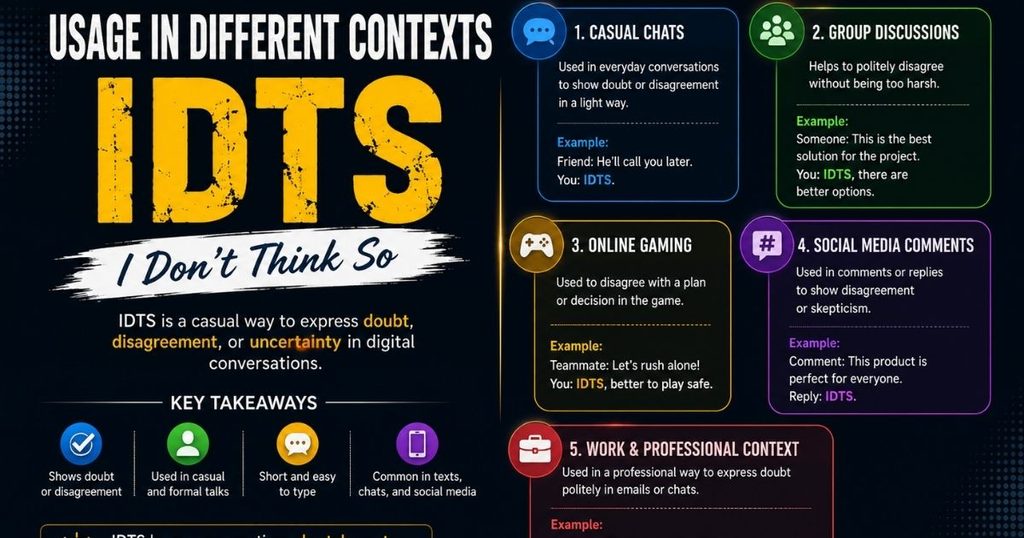
IDTS keeps the same core meaning everywhere, but how appropriate it is depends heavily on where and with whom you’re using it.
1. Social Media
On Instagram, TikTok, and X, IDTS is practically everywhere. It’s a fast way to voice an opposing opinion in a comment thread without writing an essay.
“This team is winning the championship this year.” “IDTS, their defense has been shaky all season.”
2. Friends & Relationships
Among close friends, IDTS feels effortless and low-stakes. It can even carry a flirty or teasing undertone depending on the relationship.
“You’re definitely beating me at this game.” “IDTS 😎”
3. Work or Professional Settings
This is where caution matters. IDTS might slide in an informal Slack message with a coworker you’re close to, but it reads as sloppy or dismissive in most professional exchanges.
Instead of: “IDTS this’ll work.”
It’s better to write: “I don’t think this approach will be effective here’s why.”
Clear, spelled-out language builds more credibility in a work context than shorthand ever will.
4. Casual vs Serious Tone
Better suited to a casual tone:
- Everyday chat messages
- Comment sections
- Friendly, low-pressure conversations
Best avoided in a serious tone:
- Academic writing
- Formal emails
- Job applications or workplace reports
5. Gaming Communities
In multiplayer games and voice-chat-adjacent text channels, IDTS shows up constantly during live matches quick doubt about a strategy call, a teammate’s plan, or an opponent’s next move, typed out in the split second between rounds.
6. Customer Support and Casual Business Chats
Some brands with a younger, informal social media voice will occasionally use light slang like IDTS in comment replies to match their audience’s tone though this is the exception, not the rule, and it’s usually reserved for casual platforms rather than direct customer service tickets.
Common Misunderstandings About IDTS
Because abbreviations get typed quickly and read even faster, they’re easy to misinterpret. Here are the mix-ups that come up most often.
1. Thinking It Means Agreement
Some readers assume IDTS means “I do think so” and take it as confirmation rather than doubt. It’s actually the opposite a rejection or hesitation, not an endorsement.
2. Assuming It’s Always Rude
On its own, IDTS reads as fairly neutral. Tone almost always comes from the surrounding context punctuation, emojis, or the relationship between the two people chatting.
3. Using It in Formal Situations
Dropping IDTS into a formal email or academic assignment instantly undercuts the tone of professionalism the writing is going for. It’s built for casual exchanges, not polished writing.
4. Misreading Sarcasm
Between friends, IDTS is sometimes used ironically, where the real meaning is closer to “obviously.” For example:
“You love waking up early.” “IDTS.”
Here the sarcasm is clear from context the friend clearly does not enjoy early mornings, and the reply is a joking exaggeration.
Comparison Table: IDTS vs Similar Internet Terms
| Term | Meaning | Typical Tone | When Used |
| IDTS | I don’t think so | Doubtful or disagreeing | Casual chats |
| IDK | I don’t know | Neutral uncertainty | Text messages |
| IMO | In my opinion | Opinion-based | Discussions |
| TBH | To be honest | Honest or blunt | Social media |
| NGL | Not gonna lie | Casual honesty | Online posts |
| For Sure | Absolute agreement | Confident | Spoken or written |
Key Insight
What sets IDTS apart from blunt terms like “No” or “Wrong” is that it disagrees softly. It leaves the conversation open rather than shutting it down outright.
Variations and Related Expressions
Plenty of other phrases carry a similar meaning to IDTS, each with a slightly different shade of doubt or disagreement.
1. IDK About That
Leans more toward uncertainty than outright disagreement.
2. I Doubt It
A firmer, more confident version of skepticism than IDTS.
3. Probably Not
A polite, neutral way to voice mild doubt.
4. Not Really
Soft disagreement without much emotional weight.
5. I Don’t Think That’s Right
The more formal, spelled-out cousin of IDTS.
6. Maybe Not
One of the gentlest ways to disagree.
7. I’m Not Sure
Sidesteps direct rejection entirely by focusing on personal uncertainty.
8. Hard To Believe
Leans toward genuine skepticism about a claim.
9. Unlikely
A more analytical, almost statistical way to express doubt.
10. No Way
A much stronger, more emotionally charged disagreement than IDTS.
How to Respond When Someone Uses IDTS
If someone replies to you with IDTS, how you respond depends on the mood of the conversation.
Casual Replies
“Haha, maybe you’re onto something.” “Yeah, could be right about that.” “Guess we’ll find out.”
Funny Replies
“Watch me prove you wrong.” “Bet.” “We’ll see who’s right 😄”
Mature / Confident Replies
“Fair enough, we’ll see how it plays out.” “I get where you’re coming from.” “You might have a point there.”
Private or Respectful Replies
“Appreciate you being straight with me.” “Good perspective, I’ll think it over.” “Thanks for the honest take.”
Keeping your reply light and easygoing tends to keep the whole exchange friendly, even when you disagree with the disagreement.
Regional & Cultural Usage
Internet slang travels fast, but the way people actually use terms like IDTS still shifts depending on cultural norms around directness.
Western Culture
In North America and much of Europe, IDTS is a fixture of everyday texting, gaming chats, and social media banter. It’s generally read as harmless and casual, rarely raising an eyebrow.
Asian Culture
In many parts of Asia, communication styles tend to favor indirectness, so softer alternatives like “maybe not” or “I’m not sure” are sometimes preferred over blunt slang. That said, younger, internet-savvy users still use IDTS freely in casual online spaces.
Middle Eastern Culture
In several Middle Eastern cultural contexts, openly disagreeing can be seen as impolite outside of close relationships. As a result, IDTS tends to stay within tight friend groups rather than more public or mixed-company conversations.
Latin American Culture
Across much of Latin America, digital communication tends to be warm and expressive, and English-language slang like IDTS has been picked up widely among younger, bilingual internet users often mixed naturally into Spanish or Portuguese sentences.
Global Internet Culture
Online spaces have effectively created a shared, borderless slang vocabulary. Terms like IDTS, IDK, TBH, and IMO are recognized well beyond their countries of origin, which has made cross-cultural digital conversation noticeably faster and more fluid.
Frequently Asked Questions
What does IDTS mean in texting?
IDTS stands for “I Don’t Think So.” It’s a casual way of expressing doubt or disagreement in a text or online message.
Is IDTS rude?
Not typically. It usually reads as neutral or even playful the tone depends heavily on context and any emojis attached to it.
Where is IDTS commonly used?
Most often on WhatsApp, Instagram comments, TikTok replies, X (Twitter) threads, and gaming or Discord chats.
Is IDTS formal or informal?
Strictly informal. It belongs in casual conversations, not professional emails or academic writing.
Can IDTS be sarcastic?
Yes. Among close friends, it’s sometimes used ironically to mean the opposite of what it literally says.
What is the opposite of IDTS?
Phrases like “I think so,” “Definitely,” or “For sure” express the opposite sentiment confidence or agreement rather than doubt.
Do older people use IDTS?
It’s most common among younger, internet-native users, but anyone comfortable with texting slang regardless of age can and does use it.
Conclusion
At its core, IDTS is simply shorthand for “I don’t think so.” It’s a quick, low-friction way to express doubt, skepticism, or gentle disagreement without sounding harsh or overly formal.
It might look cryptic the first time you come across it, but once you see it in a handful of real conversations, the meaning clicks immediately.
Getting comfortable with terms like IDTS helps you:
- Follow fast-moving digital conversations without confusion
- Communicate more naturally in casual online spaces
- Avoid awkward misreadings in texts, comments, and group chats
Like most internet shorthand, it works best where it was born in casual chats with friends, comment sections, and everyday online banter. Sometimes those four letters really do say just as much as a full sentence, only faster.
