
Sometimes the most important thing you can do for someone is ask the right question at the right moment. “How are you holding up?” is one of those questions it signals genuine concern, emotional awareness, and a willingness to listen beyond the surface. But using the same phrase every time can start to feel formulaic, even flat.
Whether you are checking in on a grieving friend, a stressed colleague, or a loved one going through a difficult season, having a range of alternatives helps you communicate with more warmth and intention.
This guide gives you 27+ thoughtful, human-sounding ways to ask the same question, each explained with context so you always know which one fits the moment.
When Should You Use These Alternatives?
Before diving into the list, it helps to understand when and why you would reach for an alternative to the standard phrase. The original question, “How are you holding up?” is already an upgrade from the generic “How are you?” It acknowledges that the other person may be under pressure, managing difficulty, or simply going through a lot. But there are several reasons to diversify your language.
Key Situations That Call for a Different Approach:
- You have already used the same phrase several times in recent conversations and want to sound more present.
- The other person’s situation is evolving, so the tone of your check-in should evolve too.
- You are writing a message rather than speaking, and certain phrases land differently in text.
- You want to open a deeper conversation rather than receive a surface-level “I’m fine” response.
- The relationship is professional and you need a phrase that is caring but appropriate for the workplace.
- The person has experienced grief, loss, burnout, or illness, and you want your words to reflect that sensitivity.
| Situation | Best Phrase Tone | Example Approach |
| Friend going through grief | Tender and open | “How are you carrying all of this?” |
| Colleague under work pressure | Professional and warm | “How are you managing everything?” |
| Partner or family member | Intimate and direct | “How are you really doing?” |
| Distant friend catching up | Light and curious | “How’s life treating you lately?” |
| Someone after a long silence | Gentle and spacious | “How have things been lately?” |
| Someone in ongoing difficulty | Steady and grounding | “How are you staying steady?” |
Understanding the context behind each phrase helps you avoid the common mistake of asking a deeply emotional question in a casual tone, or sending something too heavy in a professional setting.
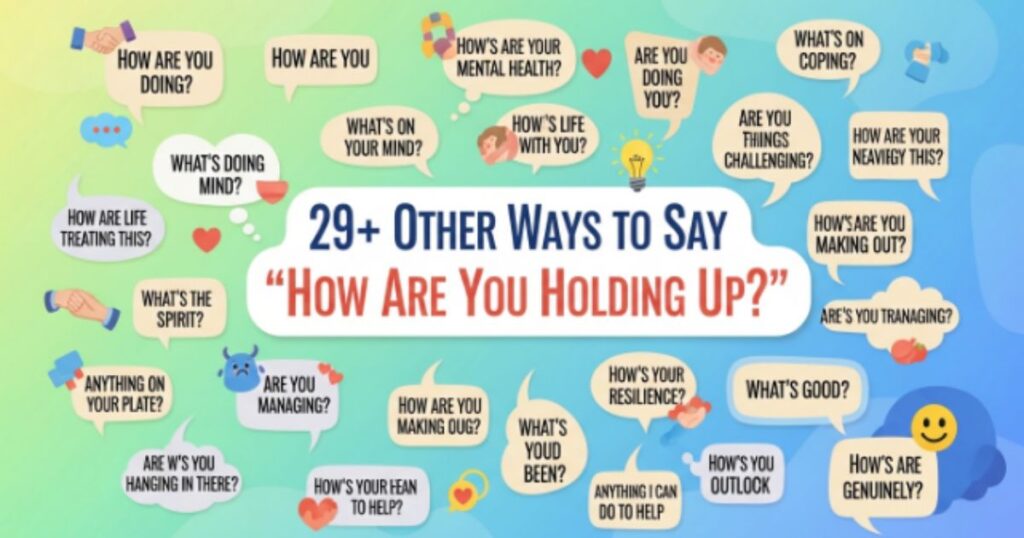
29+ Other Ways to Say “How Are You Holding Up?”
1. “How are you doing today?”
A simple, clean alternative that works in almost any setting. It focuses on the present moment without assuming anything about the person’s emotional state, making it a good opener.
2. “How have you been managing?”
This phrase gently acknowledges that the person has things to handle without being dramatic about it. It is ideal when someone is going through a prolonged stressful period and you want to check in regularly.
3. “How are things going for you?”
Slightly broader than a direct emotional check-in, this phrasing invites the person to share on their own terms. It is casual enough for a text message but warm enough for a meaningful conversation.
4. “How are you coping?”
This is a more direct alternative that signals you are aware they are dealing with something significant. Use it when you know the context and want to open the door to a more honest exchange.
5. “How are you feeling about everything?”
An emotionally intelligent phrase that gives the other person room to define what “everything” means to them. It is excellent for deeper personal conversations and avoids putting words in their mouth.
6. “How’s everything holding up on your end?”
Slightly more casual and often used in professional contexts, this version is great for emails, Slack messages, or work check-ins where you want to show care without overstepping.
7. “How have things been lately?”
Warm and open-ended, this phrase works well after a gap in communication. It does not presume anything and leaves the other person free to share as much or as little as they want.
8. “How are you getting through it?”
This phrasing implicitly acknowledges that the person is going through something difficult and expresses confidence that they are getting through it. It is both supportive and forward-looking.
9. “How are you holding up these days?”
A slight variation of the original that feels more conversational. Adding “these days” softens the question and makes it feel like part of an ongoing, caring dialogue.
10. “How’s your mental space lately?”
A more modern, direct phrase that invites someone to talk about their emotional and psychological wellbeing without couching it in vague language. Best for close friendships where this kind of openness is welcome.
11. “Are you doing okay?”
Short, simple, and deeply human. This question is often underestimated. Its directness can feel more genuine than a longer phrasing, especially when delivered with the right tone of voice or framing in a message.
12. “How are you feeling these days?”
Focuses specifically on feelings and emotional state. This is a good phrase for checking in on someone who has been going through an extended difficult period like illness, recovery, or a life transition.
13. “How are you managing everything?”
Similar to asking how someone is coping, but with a subtle acknowledgment that they are juggling multiple things at once. It shows you are paying attention to the complexity of their life.
14. “How’s life treating you lately?”
Warmer and slightly more playful than some of the other options, this phrase is great for reconnecting with someone after time apart. It invites a broad, honest answer without feeling heavy.
15. “How are you really doing?”
The addition of “really” does a lot of work. It signals that you are not looking for a polished, socially acceptable answer. You want the truth. Use this when you have established trust and the other person needs permission to be honest.
16. “How are you feeling holding everything together?”
This phrasing recognizes and honors the effort someone is making just to keep things functioning. It is a deeply empathetic question that acknowledges invisible labor, whether emotional, logistical, or relational.
17. “How are things emotionally?”
Specific and direct, this phrase removes any ambiguity about what kind of check-in you are offering. It tells the other person you are interested in their emotional life, not just their external circumstances.
18. “How are you dealing with everything?”
A grounded, no-nonsense phrase that works across a wide range of relationships. It is honest without being dramatic and makes clear you are aware that things are not simple for them.
19. “How’s your energy these days?”
A thoughtful and often overlooked angle. Asking about someone’s energy rather than their emotions can sometimes feel less pressurizing, opening the door to a more comfortable conversation about how they are really doing.
20. “How are you staying afloat?”
This phrase uses vivid, relatable imagery to acknowledge that someone is navigating difficulty. It is empathetic without being heavy and works well when the person has been managing a sustained period of stress.
21. “How are you handling things right now?”
Direct and grounded, this alternative is useful when you know something specific is going on and want to acknowledge it without being overly dramatic. It suits both personal and professional contexts.
22. “How’s your heart these days?”
A tender, poetic alternative that moves beyond logical or logistical check-ins. It speaks directly to emotional wellbeing and is best reserved for close relationships where that level of intimacy is already established.
23. “How are you feeling through all of this?”
The phrase “all of this” implies an ongoing situation rather than a single event. It communicates that you have been following along and are not just asking out of politeness.
24. “How are you keeping yourself together?”
Acknowledges the effort it takes to hold one’s composure during difficult times. It is validating and shows that you recognize the person is actively working to stay functional.
25. “How’s everything feeling right now?”
Slightly more present-tense than some other options, this question focuses on the immediate moment. It is gentle, spacious, and gives the person room to share what is weighing on them most.
26. “How are you carrying all of this?”
A beautifully human phrase that uses the weight metaphor to acknowledge burden without dramatizing it. It is ideal for someone going through grief, caretaking responsibilities, or major life upheaval.
27. “How are you staying steady?”
This phrase presumes the person has strength and resilience, which is quietly affirming. It asks them to reflect on their coping mechanisms, which can itself be a grounding exercise.
28. “How are you doing, all things considered?”
The closing phrase “all things considered” acknowledges complexity without spelling it out. It is polite, warm, and works in nearly any relationship or context.
Bonus Section: Short, Gentle Check-In Texts
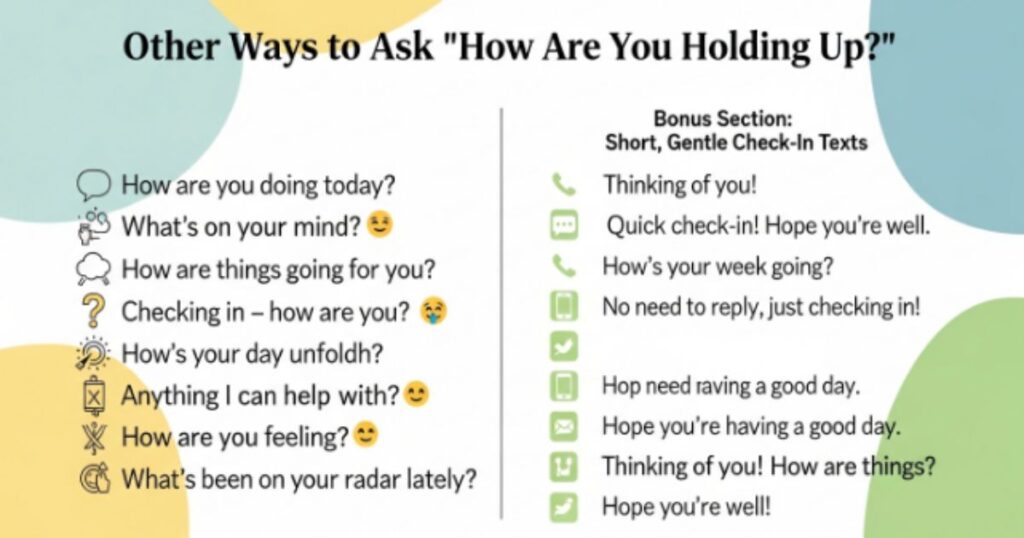
Sometimes you want to send something that says “I’m thinking of you” without opening a long conversation. These short check-in phrases are perfect for a quick text, a WhatsApp message, or a comment on someone’s post.
Short Check-In Messages:
- “Just checking in. How are you?”
- “Thinking of you. Hope things are okay.”
- “No pressure to respond. Just wanted you to know I’m here.”
- “How’s your week looking? Anything I can help with?”
- “You’ve been on my mind. Doing okay over there?”
- “Hey. Just wanted to check in. You good?”
- “How are things on your end? Here if you need anything.”
These short phrases follow the same principle as the longer alternatives: they signal genuine concern, give the person space to respond at their own level of depth, and do not demand anything in return. Emotional intelligence in communication is not about saying more. It is about saying the right thing.
| Message Length | Best Used When | Key Tone |
| Long, thoughtful phrase | Serious life events, grief, loss | Warm and deeply empathetic |
| Medium check-in | Stress, burnout, transitions | Caring and present |
| Short text | Regular check-ins, casual concern | Light, available, non-intrusive |
| Written card or letter | Milestones, recovery, major changes | Personal, lasting, meaningful |
Why Word Choice Matters in Emotional Check-Ins
The way you phrase an emotional check-in shapes not just the answer you receive but the emotional safety of the entire conversation. Research in communication psychology consistently shows that open-ended questions invite more honest and elaborate responses than closed questions.
When you ask “Are you fine?” the social default is yes. When you ask “How are you really doing?” or “How are you carrying all of this?” you communicate that you are prepared to hear something more honest.
Principles of Effective Emotional Check-Ins:
- Open-ended phrasing invites more genuine responses than yes or no questions.
- Acknowledging difficulty explicitly, without naming it directly, reduces the social awkwardness of vulnerability.
- Tone matters as much as word choice, especially in spoken conversations.
- Following up on a previous check-in signals consistency and genuine interest.
- Keeping the pressure low and the door open allows people to come in when they are ready.
The goal of asking how someone is holding up is never really about getting information. It is about making another person feel seen and less alone. That is a deeply human act, and the words you choose in service of that act carry more weight than most people realize.
With 27+ alternatives now in your vocabulary, the last step is learning to choose well in the moment. Here are a few practical guidelines to help you match the right phrase to the right situation every time.
Frequently Asked Questions
What does “how are you holding up” mean?
It means asking how someone is coping or managing during a difficult or stressful time, showing empathy and genuine concern for their wellbeing.
When should I use an alternative to “how are you holding up?”
Use an alternative when the phrase feels repetitive, when the situation calls for a different tone, or when you want to open a deeper and more honest conversation.
Is “how are you really doing?” too direct?
Not if the relationship supports it. The word “really” invites honesty and signals you are prepared to listen, which most people appreciate from someone they trust.
Can I use these phrases in professional settings?
Yes. Phrases like “How are you managing everything?” or “How’s everything holding up on your end?” are professional, warm, and appropriate for workplace communication.
What is the most empathetic way to check in on someone?
Acknowledge their situation without dramatizing it, use open-ended phrasing, keep the tone gentle, and make it clear that no particular response is expected or required.
How do I check in without being intrusive?
Keep the message short, make clear you are not expecting a detailed response, and offer your availability without attaching any pressure to it.
What are good check-in words for a grieving person?
Phrases like “How are you carrying all of this?” or “How’s your heart these days?” are tender, acknowledging without minimizing what they are experiencing.
Conclusion
With 27+ alternatives now in your vocabulary, the last step is learning to choose well in the moment. Here are a few practical guidelines to help you match the right phrase to the right situation every time.
Tips for Choosing the Right Check-In Phrase:
- Consider the depth of your relationship first. Some phrases are intimate and belong only in close friendships. Others are universally appropriate.
- Think about what the person is actually going through. Grief, burnout, health challenges, and work stress all call for different tones.
- In writing, read the phrase aloud before sending. Does it sound like you or does it sound like a template?
- Avoid stacking multiple check-in questions in one message. Pick one phrase and let the conversation unfold naturally.
- If the person deflects, do not push. Offer your presence and leave the door open gently.
- When in doubt, simpler is warmer. “I’m here if you need me” does more than a paragraph of well-intentioned questions.
Finding your own natural way to check in on someone is a skill that grows over time. These phrases are not scripts. They are starting points. The best version of any one of them is the one that sounds most like you, said with genuine care for the person in front of you.
