
“Safe travels” is one of those phrases people say so naturally that its deeper meaning often goes unnoticed. Whether someone drops it at an airport farewell, adds it to the end of a work email, or types it in a WhatsApp message before a road trip, the words carry more emotional weight than they appear to on the surface.
This article gives you a thorough look at what safe travels actually means, where it came from, how to use it correctly in different settings, and how to respond when someone sends it your way. You will also find real conversation examples, cultural context, common mistakes to avoid, and a full FAQ section to answer every lingering question.
Safe Travels Quick Meaning
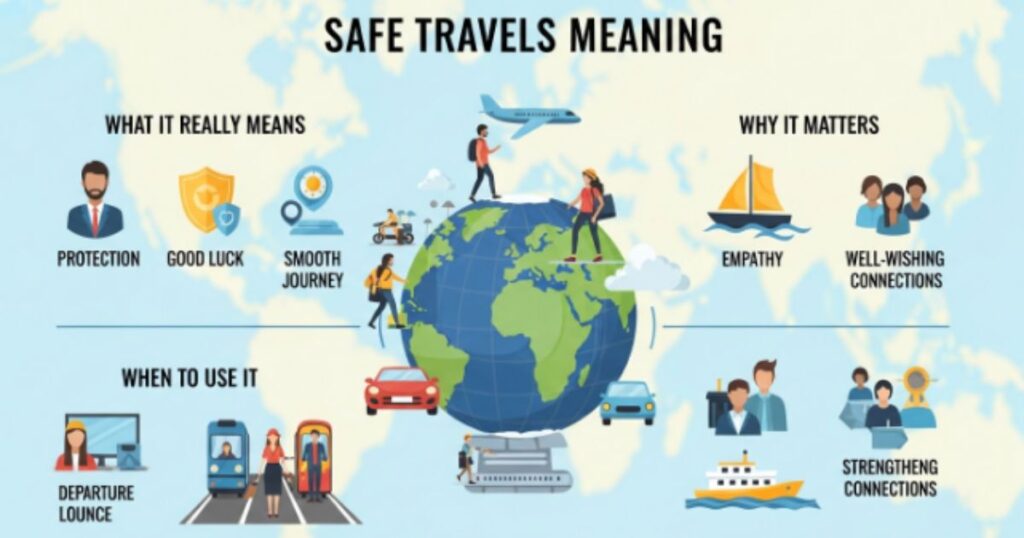
At its simplest, “safe travels” is a polite and sincere wish for someone to have a smooth, secure, and trouble-free journey. The word “travels” is used in the plural form because it refers to all the moving parts of a trip, the flights, layovers, drives, and transfers, not just a single moment of departure.
Simple breakdown:
- It is a farewell expression used before someone embarks on a trip
- It signals care, concern, and emotional investment in the other person’s wellbeing
- It applies to all travel types, whether by air, road, rail, or sea
- It works in both casual and semi-formal communication
Quick examples:
- “Safe travels! Let me know when you land.”
- “Enjoy your trip to Tokyo. Safe travels!”
- “Long drive ahead. Drive carefully and safe travels.”
- “See you on the other side. Safe travels, friend.”
Origin and Background
The phrase has roots in centuries of travel culture. In the Middle Ages, departing travelers in Europe were often blessed before long journeys because the roads were dangerous and the outcome was never certain. Phrases like “Godspeed” and “God be with you” served the same emotional function that “safe travels” serves today.
By the 18th and 19th centuries, written correspondence regularly included wishes for a safe journey, particularly in letters sent before sea voyages or overland expeditions. As modern transportation made travel more routine, the urgency faded but the sentiment stayed. “Safe travels” became the streamlined, secular version of those older blessings.
Today the phrase has evolved even further. Safe travels meaning now encompasses physical safety, emotional comfort, smooth logistics, and the quiet reassurance that someone at home is thinking about the traveler. It is less about danger and more about genuine human connection.
Real-Life Conversations
1. WhatsApp Chat
Person A: Just packed my bags. Heading to the airport in an hour. Person B: Finally! You have been planning this trip forever. Safe travels and text me when you board! Person A: Will do, thank you so much.
2. Instagram DM
Person A: Posted my “off to Europe” stories haha. Person B: Saw that! You are going to have the best time. Safe travels and bring back good content.
3. Text Message
Person A: Leaving for the family reunion now. Four-hour drive. Person B: Take breaks and stay alert. Safe travels, see you when you get back.
These examples show how naturally the phrase fits into everyday digital communication. It is warm without being dramatic, sincere without being over-the-top.
Emotional and Psychological Meaning

The phrase “safe travels” is what linguists call a phatic expression, language that maintains social bonds rather than conveying new information. When you say it, you are not literally predicting outcomes or issuing instructions. You are signaling care.
Research in social psychology supports this. A 2019 study published in Frontiers in Psychology found that simple verbal gestures of concern during farewells meaningfully increase perceived social support and feelings of trust between people. Saying safe travels is not just etiquette. It is a small but real act of emotional generosity.
For the person hearing it, the phrase:
- Reinforces their sense of being cared for by someone they trust
- Reduces travel-related anxiety by offering a moment of reassurance
- Creates a feeling of connection even across physical distance
- Signals that their return matters to someone
For the person saying it, the phrase provides a meaningful closure to the farewell moment. It replaces an awkward silence with something warm and purposeful.
Usage in Different Contexts
1. Social Media
On platforms like Instagram, Twitter, and TikTok, “safe travels” frequently appears in captions, story replies, and comment sections when someone announces a trip. It is short enough to fit naturally in digital communication while still conveying genuine warmth. Travel influencers often receive waves of “safe travels” comments before international content series.
2. Friends and Relationships
Between close friends and family, safe travels is a natural extension of daily care. It is used before road trips, flights, solo adventures, family visits, and even long commutes in some relationships. The phrase tends to feel most meaningful when accompanied by a small personal detail like “text me when you land” or “I want to hear everything when you are back.”
3. Work or Professional Settings
“Safe travels” is widely accepted in professional communication. It fits naturally in emails, Slack messages, or verbal goodbyes when a colleague is heading to a conference, client meeting, or international assignment. In highly formal correspondence, alternatives like “Wishing you a pleasant journey” may carry a slightly more polished register, but safe travels is appropriate in the vast majority of workplace contexts.
4. Casual vs Serious Tone
The phrase shifts easily between registers. Said lightly with an emoji it feels warm and friendly. Said quietly before someone faces a difficult journey, a medical trip, a move to another country, it carries weight and sincerity. Context, delivery, and relationship determine which end of the spectrum it lands on.
Common Misunderstandings
1. Thinking It Is Only for Flights
Many people assume safe travels is reserved for air travel. It is not. The phrase works for any form of journey: road trips, train rides, bus journeys, solo drives, cruises, or even a long walk in an unfamiliar city. The word “travels” is broad by design.
2. Assuming It Is Formal Only
Safe travels is genuinely flexible. It suits a casual text between friends just as naturally as it suits a professional farewell email. Thinking it is too formal for everyday use causes people to miss chances to express genuine care in simple, direct moments.
3. Overusing It in Non-Travel Situations
Using the phrase when someone is not actually traveling can feel odd or insincere. “Safe travels on your job interview” would confuse most people. The phrase has a specific trigger: it belongs to departure and journey situations. Stretching it beyond that loses its meaning.
4. Confusing It with “Good Luck”
“Good luck” is about outcomes and performance. “Safe travels” is about protection and wellbeing during the journey itself. They are not interchangeable. If someone is heading to a new job, “good luck” fits better. If they are physically traveling to get there, “safe travels” fits the farewell.
Comparison Table: Safe Travels vs Similar Farewell Phrases
| Phrase | Tone | Best Context | Focus |
| Safe travels | Warm, caring | Any travel farewell | Safety and wellbeing |
| Bon voyage | Formal, elegant | International or ceremonial trips | Celebration of journey |
| Godspeed | Archaic, sincere | Serious or literary contexts | Divine protection |
| Have a safe trip | Neutral, practical | Casual or semi-formal | Safety only |
| Travel safely | Gentle command | Close relationships | Caution and care |
| Take care | General, broad | Any farewell, not travel-specific | General wellbeing |
| Good luck | Performance-focused | Challenges or outcomes | Success |
Variations and Related Expressions
While “safe travels” is the most widely used form, related expressions carry similar meaning with slightly different nuance:
- “Safe trip” is shorter and more casual, often used in text messages between close friends
- “Travel safely” is a gentle instruction rather than a wish, carrying a slightly parental warmth
- “Have a good journey” is more British in usage and slightly more formal in register
- “Bon voyage” is the French equivalent, used in English for international or ceremonial departures
- “Safe journey” is direct and traditional, common in South Asian English especially
- “Get there safely” is casual and friendly, often used between peers
Each carries the same core sentiment: care for the traveler’s wellbeing from departure to arrival.
How to Respond When Someone Says Safe Travels
Casual Replies
- “Thank you! I will keep you posted.”
- “Appreciate it! Will text when I land.”
- “Thanks so much, means a lot.”
Funny Replies
- “Safe travels to my credit card too lol.”
- “Tell my bed I miss it already.”
- “If the plane delays me I am blaming you haha.”
Mature / Confident Replies
- “Thank you, I am looking forward to the trip.”
- “I appreciate that. I will be careful.”
- “Means a lot coming from you.”
Private / Respectful Replies
- “Thank you. This trip means everything to me.”
- “I needed to hear that. Will keep in touch.”
- “That really does mean something. Thank you.”
Regional and Cultural Usage
Western Culture
In the United States and United Kingdom, “safe travels” is deeply embedded in everyday farewell culture. It appears in personal texts, professional emails, social media posts, and airport goodbyes alike. Younger generations use it freely across all platforms, including TikTok captions and Instagram stories.
Asian Culture
Across many Asian cultures, the sentiment behind safe travels has deep traditional roots. In China, the expression “An Jian Fa Xing” carries the meaning of wishing someone a safe and smooth departure. In India, “Shubh Yatra” is the equivalent Hindi blessing. These cultural equivalents reflect the same universal human instinct to protect those who are journeying away from safety and familiarity.
Middle Eastern Culture
In Arabic, “Salamat” and “Ila al-liqa” are used as farewell expressions carrying wishes for safety and a good return. The concept of blessing a traveler before departure is deeply rooted in Middle Eastern and Islamic tradition, where prayers for safe passage are considered an act of sincere care.
Global Internet Usage
Search interest for “safe travels meaning” has grown steadily alongside the rise of global travel content on social media. The phrase trends noticeably after major travel events or when a well-known figure announces a long trip. It is genuinely universal, crossing language and cultural barriers because the underlying emotion needs no translation.
Why Safe Travels Still Matters in the Age of Fast Communication
In an era of short captions, voice notes, and reaction emojis, “safe travels” holds its ground because it does something most brief expressions cannot. It is specific, meaningful, and kind without being heavy. It acknowledges the reality of the moment without overstating it.
People who travel frequently report that receiving a genuine “safe travels” from someone they care about adds a small but real sense of warmth to the departure experience. It is not just words. It is proof that someone noticed you were leaving and cared enough to say something.
The Power of Safe Travels in Professional Relationships
Using “safe travels” in a workplace context does more than fill the end of an email. It humanizes professional relationships. When a manager sends it to an employee heading to a client meeting, or when a colleague says it before a teammate boards a long-haul flight, it signals that the working relationship extends beyond tasks and deliverables.
This matters more than people often realize. Small acts of verbal care in professional settings, including sincere farewell phrases, have been linked to higher perceived trust and stronger team cohesion over time. Safe travels is one of the simplest tools available for this.
Safe Travels Comparison Table: Formal vs Casual Usage
| Situation | Recommended Phrase | Tone Level |
| Friend leaving for a weekend trip | “Safe travels! Text me later.” | Casual |
| Colleague heading to a conference | “Safe travels. Hope the sessions go well.” | Semi-formal |
| Parent leaving on a long flight | “Safe travels, love you.” | Personal |
| Client departing after a meeting | “Wishing you safe travels back home.” | Formal |
| Social media farewell post | “Safe travels everyone heading to the summit.” | Public/casual |
| International business partner | “Have a safe and comfortable journey.” | Formal |
FAQs About Safe Travels Meaning
1. What does “safe travels” mean exactly?
It is a sincere wish for someone to have a smooth, secure, and trouble-free journey, covering physical safety, emotional comfort, and the hope for a good return.
2. Is “safe travels” formal or casual?
It sits comfortably in both registers. It works in professional emails just as naturally as in a casual text message between close friends.
3. Can I use it for short trips?
Yes. The phrase works for any journey, including short road trips, local commutes, or quick flights, not just long-haul international travel.
4. Is it okay to say it in emails?
Absolutely. “Safe travels” is a widely accepted closing phrase in professional emails, especially when a colleague or client is departing for a trip.
5. What is the difference between “safe travels” and “take care”?
“Take care” is a general farewell not tied to travel. “Safe travels” is specific to a departure and focuses on physical safety and journey-related wellbeing.
6. Is it outdated?
Not at all. Safe travels remains one of the most widely used and genuinely valued farewell expressions in both spoken and written communication globally in 2026.
7. Can I say it after someone leaves?
Yes, in a text or message after they have departed it still carries meaning. “Just wanted to say safe travels, thinking of you on your journey” works perfectly.
Conclusion
“Safe travels” is far more than a polished exit line. It is a phrase rooted in centuries of human concern for those who journey away from home, modernized into something short, sincere, and universally understood. When you say it, you are not performing politeness. You are offering something real.
Whether you are typing it at the end of a work email, saying it at an airport gate, or dropping it in a WhatsApp message before a friend’s solo trip, the meaning is the same: I see you leaving, I care about what happens to you, and I want you to come back well. That is never outdated, never too formal, and never the wrong thing to say.
