
Every professional has experienced that moment when a message finally clicks after someone takes the time to explain it properly. That moment deserves a genuine, well-chosen response. Saying “thank you for the clarification” is polite and widely understood, but repeating the same phrase in every email, meeting, or chat thread gradually makes your communication sound mechanical and flat.
The way you acknowledge someone’s effort to clear up confusion says a great deal about your attentiveness, emotional intelligence, and communication maturity.
Whether you are responding to a manager’s follow-up email, acknowledging a client’s correction, or thanking a colleague for breaking down a complex process, choosing the right words strengthens relationships and keeps conversations moving forward productively.
This guide gives you 26 natural, tested alternatives paired with real-world usage tips, comparison tables, and bonus ready-to-use messages. Every phrase here fits seamlessly into professional email writing, workplace dialogue, customer service communication, and casual conversation.
When Should You Use These Alternatives?
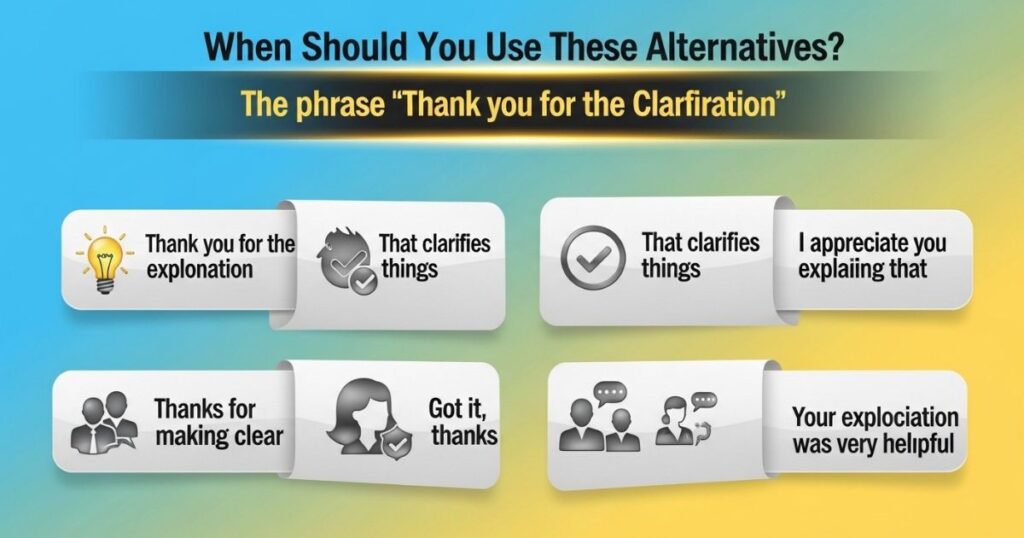
The phrase “thank you for the clarification” is appropriate in nearly every professional setting, but context determines which alternative fits best.
A quick Slack response calls for something brief and warm. A formal email to a client or senior executive benefits from a more measured, structured phrase. Using the same expression across every channel, regardless of formality or relationship, can come across as lazy or inattentive.
Research by the Chartered Institute of Personnel and Development found a 28 percent reduction in time spent clarifying messages among teams that practice clear communication acknowledgment.
When you respond to a clarification with a purposeful, specific phrase rather than a generic one, you demonstrate active listening and signal that the message truly landed, not just that you received it.
Here is a situational guide to help you match tone to context:
| Situation | Recommended Tone | Best Phrase Style |
| Formal client email | Professional and specific | “I appreciate you taking the time to clarify.” |
| Team meeting acknowledgment | Warm and collaborative | “Thanks for helping us stay aligned.” |
| Manager or senior leader reply | Respectful and concise | “I’m grateful for the clarification.” |
| Casual colleague message | Friendly and natural | “Thanks for clearing that up.” |
| Customer service interaction | Polished and empathetic | “That clears things up. Thank you.” |
| Quick text or chat reply | Brief and genuine | “Thanks for the quick clarification.” |
26+ Other Ways to Say “Thank You for the Clarification”
Each phrase below includes a clear explanation of its tone, best use case, and practical tips so you can choose with confidence every time.
1. Thanks for clearing that up.
This casual, approachable phrase works well in everyday professional conversations where you want to sound natural rather than rehearsed. It confirms understanding without overstating the effort involved.
Best for: Team chats, informal emails, and colleague conversations.
2. I appreciate the clarification.
A dependable, professional alternative that works across almost every setting. Dropping “thank you” and leading with “I appreciate” gives the sentence a slightly warmer, more personal tone while keeping full professionalism intact.
Best for: Email replies to managers, clients, and formal counterparts.
3. Thank you for explaining that.
This phrase specifically acknowledges the act of explaining, which adds a layer of recognition for the effort the person put into making things clearer. It suits contexts where the explanation required real thought or detail.
Best for: Technical discussions, onboarding communications, and process walkthroughs.
4. That makes sense now, thank you.
A human and conversational phrase that confirms understanding in real time. The structure signals that confusion has been genuinely resolved, which reassures the person that their explanation succeeded.
Best for: Verbal meetings, video calls, and back-and-forth email threads.
5. Thanks for the detailed explanation.
Use this when someone went beyond a basic answer and provided depth, examples, or supporting context. The word “detailed” specifically honors the extra effort, making this phrase more impactful than a generic thank-you.
Best for: Complex technical questions, policy explanations, and multi-step processes.
6. Thanks for confirming.
Short and professional, this phrase works when you needed a yes or no type of clarification rather than a full explanation. It is efficient and respectful without adding unnecessary formality.
Best for: Quick confirmation emails, scheduling threads, and approval chains.
7. Thanks for helping me understand.
This phrase carries a sense of genuine learning and intellectual humility. It works especially well when the clarification helped you grasp something that was previously unclear or unfamiliar, not just fix a surface-level misunderstanding.
Best for: Learning environments, new employee communications, and mentoring exchanges.
8. I’m glad you clarified that, thank you.
Adding “I’m glad” shifts the tone toward warmth and relief. It signals that the clarification mattered and that you genuinely appreciate it rather than just acknowledging it out of courtesy.
Best for: Situations where a misunderstanding could have caused a real problem had it gone unaddressed.
9. Thanks for the quick clarification.
The word “quick” specifically recognizes that the person responded promptly, which adds a layer of appreciation beyond the clarification itself. It acknowledges both the content and the responsiveness.
Best for: Fast-moving email threads, time-sensitive projects, and real-time communication channels.
10. Thanks for walking me through it.
This phrase implies a process, suggesting the person guided you step by step rather than just dropping an answer. It works well when someone took genuine time to lead you through something methodically.
Best for: Training sessions, troubleshooting discussions, and complex process explanations.
11. Thank you for the added context.
Context is often what transforms a confusing message into a clear one. This phrase specifically acknowledges that the background information or additional framing made the difference, which is a specific and thoughtful form of appreciation.
Best for: Strategy discussions, background briefings, and situations where the original message lacked context.
12. Thanks for pointing that out.
Useful when the clarification involved correcting a misunderstanding you had, drawing attention to an error, or flagging something you missed. It is humble, direct, and professionally appropriate without sounding overly formal.
Best for: Error corrections, fact checks, and situations where a misinterpretation was caught.
13. I appreciate you taking the time to clarify.
This phrase does two things well: it acknowledges the clarification itself and specifically honors the time the person spent on it. In a busy workplace, recognizing that someone made time for you carries real weight.
Best for: Detailed email responses, situations involving senior colleagues or clients, and formal correspondence.
14. Thanks for correcting me.
One of the most honest and professionally mature phrases in this list. It acknowledges that you were wrong or misunderstood something, which takes humility and signals openness to feedback. Used well, it actually builds credibility.
Best for: Professional exchanges where an error or misconception has been respectfully corrected.
15. Thanks for making that clearer.
A simple and effective phrase that acknowledges improvement in understanding. The comparative “clearer” implies that your understanding has moved forward, which is both accurate and gracious.
Best for: Follow-up emails after a confusing initial message, and conversations where partial understanding existed before the clarification.
16. Thanks, now I see what you mean.
Conversational and natural, this phrase confirms real comprehension in a way that sounds genuine rather than formulaic. It reassures the other person that their explanation worked and communication has been restored.
Best for: Verbal exchanges, instant messaging, and informal written communication.
17. That clears things up. Thank you.
Two short sentences that pack a lot of communication value. The first confirms the outcome and the second expresses appreciation. Together they are clean, professional, and reader-friendly.
Best for: Email sign-offs, brief acknowledgment messages, and professional chat replies.
18. Thanks for the clarification, really helpful.
Adding “really helpful” gives the phrase an extra layer of sincerity and specificity. It tells the person not just that you heard them, but that what they shared actually moved things forward for you.
Best for: Project emails, team discussions, and situations where the clarification had direct practical value.
19. I’m grateful for the clarification.
Slightly more formal and emotionally elevated than a standard thank-you, this phrase works well in writing where you want the appreciation to carry genuine weight. Using “grateful” signals a deeper level of recognition.
Best for: Formal written correspondence, senior professional exchanges, and any situation where the clarification resolved a meaningful issue.
20. Thanks for clearing up the confusion.
This phrase is particularly effective when a genuine misunderstanding existed and needed to be corrected. Naming the confusion directly makes the acknowledgment feel specific and honest rather than routine.
Best for: Situations following a miscommunication, dispute, or misinterpretation.
21. Thanks for specifying.
A concise and professional phrase that works when someone narrowed down or defined something more precisely. The word “specifying” acknowledges that precision was what was needed, which is a targeted and thoughtful form of recognition.
Best for: Situations involving technical language, ambiguous instructions, or multi-option decisions that needed to be narrowed down.
22. Thanks for breaking it down.
This phrase is ideal when someone simplified a complex idea by dividing it into smaller, more digestible parts. It acknowledges both the effort and the skill involved in making something accessible.
Best for: Training materials, educational contexts, technical explanations, and presentations where simplification was needed.
23. Thanks for the clarification, much appreciated.
A polished and widely accepted phrase in professional English. The addition of “much appreciated” adds warmth without sacrificing professionalism, and it works well as a closing line in business emails.
Best for: Email sign-offs, formal replies, and professional correspondence across all levels.
24. I appreciate you clearing up that misunderstanding.
This phrase is particularly powerful when a real misunderstanding was at the center of the exchange. It names the issue directly and thanks the person for resolving it, which shows maturity and situational awareness.
Best for: Conflict resolution follow-ups, team realignment conversations, and any exchange where miscommunication caused friction.
25. Thank you, that answers my question.
Direct and effective, this phrase confirms that the clarification fully resolved what you needed to know. It brings the conversation to a natural close while expressing genuine appreciation for a complete answer.
Best for: Q and A sessions, help desk interactions, client communications, and support exchanges.
26. Thanks for helping us stay aligned.
This phrase expands the appreciation beyond a personal exchange and acknowledges the team-wide benefit of the clarification. It works especially well in group or project contexts where shared understanding is critical to progress.
Best for: Team emails, project management communications, and multi-stakeholder discussions.
How Tone Shapes the Impact of Your Response
Choosing the right tone is as important as choosing the right phrase. The same level of gratitude can land very differently depending on the words you select and the relationship you have with the recipient. Here is a comparison table to help you calibrate your response:
| Phrase | Tone | Formality Level | Ideal Channel |
| Thanks for clearing that up | Casual, warm | Low | Slack, text, informal email |
| I appreciate the clarification | Neutral, professional | Medium | Standard email, meeting follow-up |
| I’m grateful for the clarification | Sincere, formal | High | Executive email, formal correspondence |
| Thanks for walking me through it | Warm, appreciative | Medium | Training follow-ups, onboarding |
| Thanks for correcting me | Humble, honest | Medium | Error corrections, feedback responses |
| I appreciate you taking the time to clarify | Formal, respectful | High | Senior colleague or client communication |
| Thanks, now I see what you mean | Conversational, natural | Low | Chat, verbal exchanges |
| Thanks for helping us stay aligned | Collaborative, team-focused | Medium | Project emails, group communications |
The Real Reason Acknowledgment Language Matters

Many professionals treat acknowledgment phrases as filler, something added out of habit before getting to the actual content of a message. In reality, the way you acknowledge a clarification communicates far more than simple courtesy. It signals whether you were truly listening, whether you understood the effort behind the explanation, and whether you intend to act on the information provided.
A Gallup study found that employees who feel recognized in their professional interactions are four times more likely to be actively engaged in their work. While that research focuses on managers recognizing team members, the principle extends to all professional communication.
When you take the time to select a phrase that specifically reflects what the clarification meant to you, the recipient feels genuinely acknowledged rather than processed.
Good communication acknowledgment also reduces the likelihood of follow-up confusion. According to Berkeley Executive Education, clarity in language acts as a tool to reduce ambiguity and ensure that all parties share a genuine understanding of tasks, goals, and expectations.
A thoughtful response to a clarification signals that the message landed correctly, which prevents the back-and-forth that costs teams time and energy.
Common Mistakes to Avoid When Responding to a Clarification
Even with the right phrase selected, how you deliver your response matters. Here are the most common pitfalls professionals fall into and how to avoid each one:
Responding too generically without referencing the specific clarification. Phrases like “noted” or “okay” acknowledge receipt without confirming understanding, which can leave the other person uncertain whether their effort actually helped.
Overloading the response with gratitude to the point where it sounds insincere. Saying “I am so incredibly grateful for your absolutely brilliant clarification” reads as performative rather than genuine. Keep appreciation measured and specific.
Delaying your response after a clarification has been shared. Prompt acknowledgment tells the person their effort was valued and keeps the conversation or project moving without unnecessary interruption.
Using only casual phrases in formal settings, or only formal phrases in casual settings. Mismatching tone to context creates friction and can make the recipient feel that you either do not know them well or are not paying attention to the nature of your relationship.
Failing to add a next step when one is expected. When a clarification resolves a task-related confusion, adding a brief line about what you will do next demonstrates that understanding has been translated into action.
Bonus Section: Short Polite Texts You Can Send
Sometimes a full sentence is more than the moment calls for. These brief messages work well in instant messaging, text, or a quick chat reply where brevity is appropriate:
- “Got it. Thanks for the clarification.”
- “Really appreciate you clearing that up.”
- “That makes total sense now. Thank you.”
- “Thanks for the quick response. All clear.”
- “Appreciate you specifying. Moving forward now.”
- “Thanks. That context was exactly what I needed.”
- “Much appreciated. I’ll take it from here.”
Final Writing Tips
The most effective acknowledgment phrases share three qualities: they are specific about what was clarified, they are proportionate in tone to the relationship and setting, and they move the conversation forward rather than simply ending it.
Before sending any response to a clarification, ask yourself whether your phrase reflects exactly what the person did, whether the tone matches the channel and relationship, and whether you have indicated your next step where one is expected.
Vary your phrases across long email threads. If you thank someone for clarification in paragraph one and then again in your sign-off, use a different phrase each time. Repetition inside the same message undermines the sincerity of both expressions.
Short phrases work best in fast-paced digital environments. Longer, more considered phrases belong in formal emails, performance conversations, and high-stakes professional exchanges.
When the situation is emotionally sensitive or the clarification resolved a significant misunderstanding, a slightly more formal and specific phrase will always land better than a quick casual one.
Frequently Asked Questions
Is “thank you for the clarification” professional?
Yes, it is widely accepted in professional settings. It is polite, clear, and appropriate for emails, meetings, and formal communications.
When should I use a casual alternative instead of the formal phrase?
Use a casual phrase when communicating with close colleagues, in instant messaging, or in relaxed team environments where stiff formality feels out of place.
Can I use these phrases in customer service communication?
Absolutely. Phrases like “that clears things up, thank you” and “I appreciate the clarification” work very well in customer-facing communication because they are warm and professionally polished.
Is it wrong to say “thanks for correcting me” at work?
Not at all. It demonstrates intellectual honesty and professional maturity. It is a phrase that actually builds trust when used genuinely and without excessive self-criticism.
How do I make my acknowledgment sound more sincere?
Add a specific reference to what was clarified. For example, instead of “I appreciate the clarification,” say “I appreciate the clarification on the revised budget timeline.” Specificity is the fastest route to genuine-sounding gratitude.
Should I always respond when someone clarifies something?
Yes. Acknowledging a clarification confirms understanding, prevents repeated follow-ups, and signals that you value the person’s effort. Silence after a clarification can create uncertainty on the sender’s side.
What is the difference between “thanks for confirming” and “thanks for clarifying”?
Confirming refers to verifying something already known or suspected, while clarifying involves explaining something that was confusing or unclear. Use “thanks for confirming” for yes or no responses and “thanks for clarifying” for more substantive explanations.
Conclusion
The language you use to acknowledge someone’s explanation is a direct reflection of how much you value clear communication and the relationships behind it.
Repeating the same phrase in every exchange, no matter how polite, eventually reduces the impact of your gratitude and makes your professional correspondence feel automated. Having a range of natural, context-aware alternatives gives you the flexibility to respond with precision and sincerity every single time.
The 26 phrases in this guide, paired with tone comparisons, practical tips, and ready-to-use short messages, cover every professional communication need from a quick team chat to a formal client email.
Put them to use deliberately, match them to your context, and pair them with a brief indication of your next step whenever possible. Clear, intentional acknowledgment is one of the simplest and most powerful habits you can build in professional communication, and it costs nothing more than a moment of thoughtful word choice.
