
Seen “PMO” pop up in a text or comment and had no clue if it was good or bad? You are not alone. PMO meaning shows up constantly in Gen Z conversations, and it can mean two completely different things depending on the message.
This guide breaks down the full PMO meaning, covering both common definitions and how to tell them apart in real conversations. You will also see how the term shows up on different platforms, in gaming chats, and in everyday sentences people actually send. We will cover a few related slang terms too, so nothing about modern texting feels confusing. Let’s dive into it properly.
What Does PMO Mean?
PMO meaning depends heavily on context, since the abbreviation carries two very different definitions. The most common one is “pisses me off,” used to show frustration or annoyance.
The second meaning is “put me on,” which works as a request for a recommendation, an introduction, or access to something worth checking out.
Reading the tone of the message is the fastest way to tell which meaning fits. An angry sounding sentence usually points to frustration, while a curious or asking tone points to a request.
Neither meaning is more correct than the other. Both versions of PMO meaning are widely used, and confusion usually only happens when someone reads a message without paying attention to the surrounding words.
Once the pattern becomes familiar, switching between the two meanings feels natural, since most sentences give away the intended meaning within the first few words.
What Does PMO Mean In Slang Text
In slang texting, PMO meaning almost always fits into one of two sentence patterns. It either follows a complaint, or it follows a request.
A complaint style message might read, “This traffic really PMO today,” clearly showing frustration about a situation.
A request style message might read, “PMO to a good show,” asking the other person to share a recommendation. Both patterns rely entirely on the words surrounding PMO to make sense.
Sentence length can also offer a clue. Short, blunt messages often lean toward frustration, while slightly longer messages asking for something specific usually point toward the request style meaning instead.
Group chats tend to mix both versions constantly, which is exactly why understanding PMO meaning through context becomes such a useful skill for reading fast moving conversations.
What Does PMO Mean In Slang Word
As a standalone slang word, PMO acts less like a noun and more like a compressed phrase, slotting directly into a sentence the same way the full expression would.
This is why PMO can appear as “PMO so bad” for frustration, or “PMO to that artist” for a request, without needing extra grammar to make the sentence work.
Understanding PMO as a swapped in phrase, rather than a single word with one fixed meaning, makes both versions much easier to recognize while reading a message.
This behavior sets PMO apart from acronyms that only carry one strict meaning. Because it can slide into two different emotional registers, readers need slightly more context than usual before responding.
Most native slang users pick up on this instinctively after seeing PMO used a few times, which is why the confusion tends to fade quickly once someone becomes familiar with casual online conversation.
Origin and History of “PMO”
The frustration meaning of PMO grew out of the much older phrase “pisses me off,” a phrase that already existed in everyday spoken English long before texting culture began.
As instant messaging and early social media platforms became popular, users shortened longer emotional phrases to save time. PMO fit naturally alongside other frustration based shorthand from that era.
The second meaning, “put me on,” developed separately within urban slang communities, originally used to describe someone introducing another person to music, opportunities, or trends worth knowing about. Over time, both meanings spread widely through social media and casual texting, eventually merging into the same three letters used today.
Music and hip hop culture played a role in spreading the “put me on” version, since artists often used the phrase to describe how they discovered new talent, sounds, or opportunities through someone else’s recommendation.
Social media accelerated both meanings at roughly the same time, which is part of why PMO meaning never fully settled into a single definition the way some other slang terms eventually do.
PMO Meaning in Gaming and Discord Chats
Gamers use PMO meaning in both of its common forms, depending entirely on what is happening during a match or conversation.
A frustrated gamer might type “this lag PMO so bad,” complaining about a technical issue ruining their game.
A different player might type “PMO to a good loadout,” asking teammates for gear or strategy recommendations. Discord servers built around specific games often use both versions daily, sometimes within the very same conversation.
Voice chat during live matches rarely includes the abbreviation itself, since players tend to say the full phrases out loud when reacting in real time. The shortened version stays mostly in written channels and text based chat logs.
This pattern matches how PMO meaning behaves elsewhere online. Fast typed messages favor the abbreviation, while spoken moments naturally default back to complete sentences.
How “PMO” Is Used on Different Platforms
PMO meaning stays fairly consistent everywhere it shows up, though certain platforms lean more heavily toward one definition. The table below breaks down common patterns.
| Platform | Common PMO Meaning | Typical Use Case |
| Twitter and X | Pisses me off | Short posts expressing frustration |
| TikTok | Put me on or pisses me off | Comments asking for recommendations or venting |
| Snapchat | Put me on | Casual requests between friends |
| Discord | Both meanings equally | Gaming chats and community servers |
This table shows why reading the surrounding words matters more than the platform itself when figuring out PMO meaning.
Newer platforms tend to inherit whichever meaning was already dominant among the community that migrates there first, which explains why certain apps lean noticeably toward one definition over the other.
PMO in Texting vs. Real Life
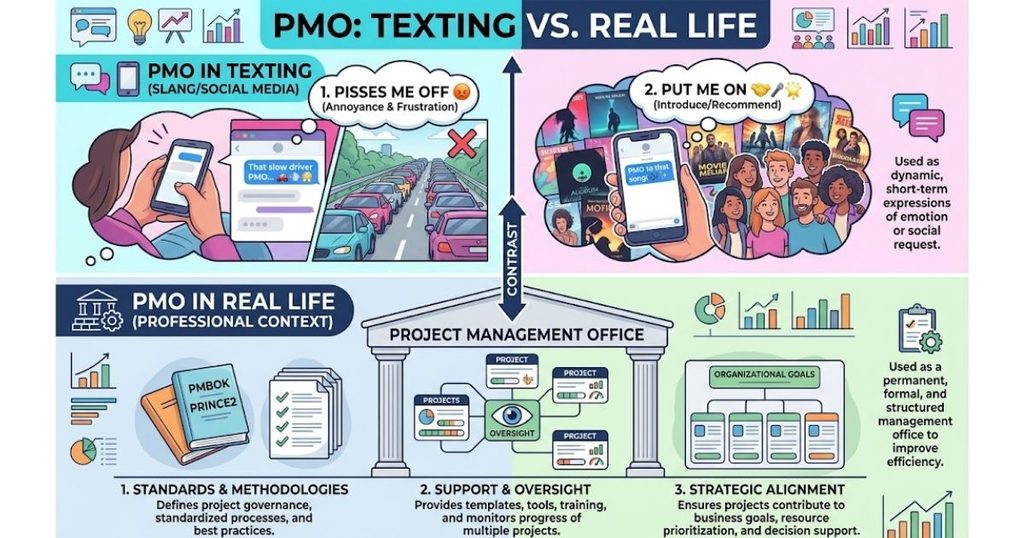
In texting, PMO works well because both meanings fit naturally into short, fast typed messages without needing extra explanation.
In real life conversations, people almost never say “PMO” out loud. Speakers tend to use the full phrases instead, since three separate letters do not translate well to speech.
This gap between texting and speech is common with most internet slang. Terms like PMO exist specifically for quick typing, not spoken conversation.
Even close friends who use PMO constantly in messages rarely bring the abbreviation into an actual phone call or in person chat, sticking instead to whichever full phrase fits the moment.
Examples of “PMO” in Sentences
Seeing PMO meaning inside real sentences makes both definitions much easier to tell apart. Here are a few natural examples.
- “People who spoil the ending PMO so much.”
- “PMO to that podcast you mentioned earlier.”
- “This delay really PMO, we have been waiting forever.”
- “Can you PMO to a good barber near you?”
These examples show both the frustrated “pisses me off” version and the curious “put me on” version, depending entirely on sentence structure.
Reading each example twice, once assuming frustration and once assuming a request, is a useful exercise for anyone still getting comfortable telling the two meanings apart in real conversations.
Variations and Related Slang
PMO belongs to a wider group of emotion and request based acronyms. Knowing a few related terms makes casual conversations easier to follow.
| Acronym | Meaning |
| SMH | Shaking my head |
| IMO | In my opinion |
| HMU | Hit me up |
| IYKYK | If you know you know |
| FR | For real |
Recognizing these patterns helps when scrolling through comment sections filled with short emotional or request based reactions.
Learning these related terms alongside PMO meaning also makes it easier to follow entire conversations, since Gen Z chats often stack several short acronyms together within a single message.
Common Mistakes People Make With PMO Meaning
The biggest mistake is assuming PMO always means one specific thing, when the correct meaning actually depends entirely on the sentence around it.
Another common mix up happens when someone replies to a frustrated PMO message as if it were a request, offering a recommendation when the sender simply wanted to vent.
Paying attention to punctuation also helps. A PMO message ending in frustration often includes words like “so bad” or “so much,” while a request usually includes “to” right after PMO.
Another mistake happens when people try to use PMO in formal writing, assuming it works like a standard abbreviation. Since both meanings rely on tone and slang context, the term rarely translates well outside casual conversation.
Double checking the sentence before replying can prevent an awkward mismatch, especially in group chats where a misread PMO message can lead to a confusing back and forth.
Is “PMO” Safe for Kids?
On its own, PMO is harmless. It simply expresses frustration or asks for a recommendation, and most uses relate to everyday situations rather than anything inappropriate.
Parents should focus more on the surrounding conversation than the abbreviation itself. Repeated venting about serious issues, or requests involving unfamiliar accounts, deserve more attention than the slang term used.
Teaching kids to recognize normal frustration versus genuinely concerning messages is more useful than worrying about PMO as a term by itself.
A helpful habit is looking at who sent the message and why. A frustrated PMO about homework reads very differently from repeated PMO messages tied to bullying or pressure from an unfamiliar account.
Open conversations about online communication tend to work better than banning individual slang terms, since new abbreviations replace old ones constantly as trends shift.
When to Use (and Avoid) “PMO”
PMO fits naturally into casual settings such as group chats, gaming servers, and comment sections where the audience already understands internet slang.
It is best avoided in professional emails, school assignments, or formal writing, since it can sound unclear or overly casual outside everyday chats.
A simple rule works here: if the setting already allows casual slang and short replies, PMO usually fits right in without confusing anyone.
It also helps to think about who is reading the message. Friends familiar with both meanings rarely misread PMO, while someone new to the term might need a quick full sentence instead to avoid confusion.
Frequently Asked Questions
What does PMO mean in a text message?
PMO in texting usually means “pisses me off” or “put me on,” depending on the sentence around it.
Does PMO always mean pisses me off?
No, PMO can also mean “put me on,” used when asking for a recommendation or introduction.
Is PMO used more by teenagers than adults?
Yes, PMO is most common among teenagers and young adults active on TikTok, Snapchat, and Discord.
How can I tell which meaning of PMO someone means?
Check the tone. Frustration sounds like a complaint, while “put me on” sounds like a request.
Where did the term PMO originally come from?
PMO grew from the phrase “pisses me off,” while “put me on” developed separately in urban slang.
Is it okay for kids to use PMO online?
Yes, PMO itself is harmless, though parents should still monitor the context around any message.
Can PMO be used in gaming chats?
Yes, gamers use both meanings of PMO regularly, often within the same Discord conversation.
Conclusion
PMO meaning depends entirely on context, splitting into two very different definitions: “pisses me off” for frustration and “put me on” for a casual request. Whether it shows up on Twitter, TikTok, or inside a Discord server, reading the surrounding words is the key to understanding it correctly.
Understanding PMO meaning makes it much easier to follow fast paced Gen Z conversations without misreading a simple text. Once the pattern clicks, telling the two versions apart becomes second nature.
