
You hear a song on TikTok, hum it through breakfast, and suddenly it is still playing in your head at midnight. You have not chosen to replay it, your brain is doing it all on its own. That experience has a name, and millions of people describe it with three simple letters: LSS.
Whether you spotted it in a WhatsApp group, an Instagram caption, or a TikTok comment section, LSS is one of those abbreviations that captures a feeling everyone shares but few people could define before they learned the term.
This guide explains everything, the meaning, the origin, the psychology behind it, how it is used across different cultures, and how to actually stop it when it will not leave your head.
LSS Meaning in Song Quick Meaning
Simple definition:
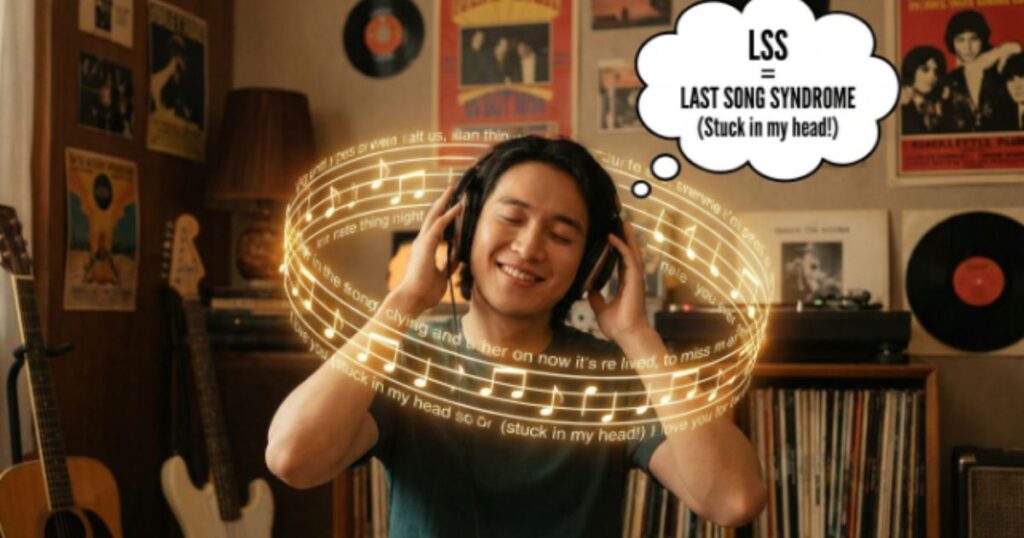
LSS stands for Last Song Syndrome. It describes the experience of having a song stuck in your head, playing on repeat in your mind, often without any effort to recall it.
The song keeps looping involuntarily, usually because it is catchy, emotionally resonant, or something you heard very recently.
LSS is not a formal medical term. It is a popular cultural shorthand, widely used in casual conversation and online communication to describe a universally relatable moment.
Quick examples:
- “I have serious LSS from that chorus, it has been three hours.”
- “Warning: this song will give you the worst LSS of your life.”
- “My brain has been playing the same eight bars on loop since this morning. Full LSS.”
Origin and Background
LSS as a term did not emerge from Western internet culture first. Its early popularity is most strongly tied to the Philippines and Southeast Asian online communities.
where the phrase Last Song Syndrome was coined and used in casual chatting on early platforms like MSN Messenger, Friendster, and later Facebook.
From there, the concept traveled with the rise of music-sharing platforms and short video content. As TikTok, Instagram Reels, and YouTube Shorts began making songs go viral in seconds.
LSS became a global term. When a 15-second audio clip loops in your head for the rest of the day, LSS is the perfect word for it.
The scientific counterpart to LSS is called an earworm, a term derived from the German word Ohrwurm. Psychologists began formally studying the earworm phenomenon in the 1990s, and research consistently shows that over 90 percent of people experience involuntary musical imagery at least once a week.
According to a Harvard Medical School expert on the neurobiological effects of music, the brain’s auditory cortex and default mode network work together to replay musical fragments, especially when a person is not fully focused on another task.
Real-Life Conversations
1. WhatsApp Chat
A: “Have you heard that new song from the playlist?” B: “Yes! Now I have LSS, the hook has been in my head all day 😭” A: “Same. Send help.”
2. Instagram DMs
A: “Just posted that reel with the trending audio.” B: “You gave me LSS with that. I hate you but the song is so good 😂”
3. TikTok Comments
User 1: “This is genuinely illegal. Instant LSS.” User 2: “The chorus hit and now it’s just… living in my brain.” User 3: “Three days of LSS and counting. No regrets.”
Emotional and Psychological Meaning
LSS is not just a fun internet abbreviation. It points to something real happening inside the brain. Psychologists describe it as involuntary musical imagery, a spontaneous mental playback of music that you did not consciously choose to recall.
Why people connect with it:
- Songs with simple, repetitive structures create neural loops that the brain naturally revisits
- Emotional attachment to a song deepens memory encoding, making it easier for the brain to replay it involuntarily
- Hearing a song frequently, even in passing on social media, increases the chance of LSS
- Stress and low cognitive engagement (like doing routine tasks) make the brain more likely to fill the gap with music
- Research published in the journal Psychology of Aesthetics, Creativity and the Arts found that earworm-prone songs tend to be faster, melodically familiar, and contain unique rhythmic intervals that set them apart from average pop tracks
People feel connected to the concept of LSS because it captures something deeply human: the way music embeds itself in our emotional memory and refuses to leave quietly.
Usage in Different Contexts
1. Social Media
On platforms like TikTok, Instagram, and Twitter, LSS appears constantly in comments, captions, and reactions. It is used to describe viral audio clips, trending songs, and any sound that users find themselves humming hours after watching a video.
Common social media uses:
- Captioning a video: “POV: you have LSS from this for the next 48 hours”
- Commenting on a music post: “This song should come with an LSS warning”
- Reacting to a reel: “Instant LSS. Reporting this post.”
2. Friends and Relationships
Between friends, LSS is a bonding term. Sharing that you have LSS from a song is often an invitation for the other person to listen to it too. It signals that a song is good enough to get stuck, which is sometimes the highest compliment a song can receive.
3. Work or Professional Settings
LSS is not appropriate in formal or professional communication. A Slack message to a colleague about quarterly reports is not the place for “giving me serious LSS rn.” The term belongs in casual, personal, or entertainment-focused spaces only.
4. Casual vs Serious Tone
| Tone | Example | Context |
| Casual and fun | “LSS from your playlist send help 😭” | Friends chatting |
| Complimentary | “This track deserves LSS honestly” | Music discussion |
| Frustrated | “Still have LSS from that ad jingle 3 days ago” | Mild complaint |
| Formal | Not applicable | Never use in professional writing |
Common Misunderstandings
1. Thinking LSS Means “Last Song Played”
LSS does not refer to the most recent song played on a device or playlist. It specifically describes a psychological experience, the involuntary loop of a song inside your mind. The song causing your LSS might be something you heard three days ago.
2. Assuming It Is Always Positive
While LSS often indicates a song is catchy or enjoyable, it is not always a compliment. Having an annoying jingle stuck in your head qualifies as LSS too. Some of the most notorious earworm-triggering songs are ones people cannot stand, but cannot stop replaying internally.
3. Using It in Formal Writing
LSS is informal internet slang. Using it in academic papers, professional emails, cover letters, or official documents will confuse readers unfamiliar with the term and appear unprofessional. Stick to casual digital spaces.
Comparison Table
| Term | Meaning | Origin | Common Platform |
| LSS | Last Song Syndrome | Philippine internet culture | TikTok, Instagram, WhatsApp |
| Earworm | Song stuck in your head | German: Ohrwurm | Academic, mainstream English |
| LSS | Long Story Short | General internet slang | Twitter, Reddit, texting |
| LSS | Lean Six Sigma | Business methodology | Professional and corporate |
| LSS | Life Support System | Medical / engineering | Clinical and technical writing |
Key Insight:
The same three letters carry completely different meanings depending on where you see them. In music and chat contexts, LSS almost always means Last Song Syndrome. In business documents or medical records, the meaning shifts entirely. Context is everything.
Variations and Types of LSS
Not all LSS experiences are the same. Here are the most common types people describe:
- Hook LSS, Only the chorus or hook plays on repeat, never the full song
- Jingle LSS, Caused by commercial or advertisement music; often the most irritating type
- Nostalgia LSS, Triggered by hearing an old song connected to a strong memory
- Viral LSS, Songs heard repeatedly through short video content like TikTok; spreads quickly across friend groups
- Accidental LSS, A random, unexpected song that lodges in your brain for no clear reason
- Shared LSS, When a song gives multiple people in the same group or household the same loop simultaneously
How to Respond When Someone Uses It
Casual Replies
- “Same! I have had it all morning 😭”
- “Which song?? Now I need to hear it”
- “That one chorus is genuinely dangerous for LSS”
Funny Replies
- “You have been infected. There is no cure.”
- “Welcome to the LSS club, we have been expecting you.”
- “Go listen to the whole song, oh wait, that makes it worse.”
Mature and Confident Replies
- “The fact that it keeps replaying means the melody really hit something emotional for you.”
- “That is actually a sign of how well-crafted the song is.”
Private or Respectful Replies
- “Haha tell me which one, I want to see if I get it too.”
- “Good LSS or the annoying kind? 😄”
Regional and Cultural Usage
Western Culture
In Western countries like the United States, the United Kingdom, Canada, and Australia, the term earworm is more commonly used than LSS in everyday speech.
However, LSS has become increasingly recognized through TikTok content shared globally, especially among younger audiences.
Asian Culture
LSS originated in and remains most naturally at home in Filipino internet culture. It is widely used across the Philippines, Indonesia, Malaysia, and other parts of Southeast Asia. In these communities, saying someone gave you LSS is a genuine compliment to a song’s quality.
Middle Eastern Culture
In Arabic-speaking online communities and across the broader Middle East, the concept is understood but the abbreviation LSS is used primarily among younger, bilingual social media users who are familiar with English internet slang.
Global Internet Usage
Thanks to TikTok and music streaming platforms, LSS has genuinely become a global term. A Finnish study found that over 90 percent of people experience involuntary musical replay at least once weekly, meaning the experience LSS describes is truly universal, even when the word for it varies.
Why LSS Has Become More Common Than Ever
The rise of short-form video content has fundamentally changed how people encounter music. A song that might have needed months of radio play to become an earworm can now achieve the same effect in hours through viral exposure.
Every time a TikTok audio loops in someone’s feed, the brain is being conditioned to replay it. LSS is not more common than it used to be, it is simply more noticeable and more openly discussed because digital culture gave it a name.
LSS vs Earworm: Same Experience, Different Worlds
The scientific community uses the term earworm. The internet uses LSS. Both describe the exact same neurological event: involuntary musical imagery powered by the brain’s auditory cortex and default mode network. The difference is tone and context.
Earworm carries a slightly clinical or formal weight, it works in psychology articles, research papers, and mainstream journalism. LSS carries a casual, affectionate energy, it belongs in group chats, comment sections, and song reviews. Neither is wrong. Both are accurate. The one you choose simply signals which world you are speaking in.
How LSS Connects Music and Memory
Music is one of the most powerful memory-encoding tools the human brain has. This is not just a cultural observation, it is backed by neuroscience.
The same brain regions that process music overlap with those involved in emotional memory, which is why songs can transport people back to specific moments in their lives instantly.
When a song causes LSS, it is often because it has tapped into one of those memory or emotion pathways. The brain keeps returning to the song not because it has nothing better to do, but because it is processing something, a feeling, a memory, an association, that the music triggered.
Frequently Asked Questions
What does LSS mean in songs?
LSS means Last Song Syndrome, the experience of having a song replay involuntarily in your mind after hearing it, especially if it is catchy or emotionally resonant.
Is LSS a good or bad thing?
It depends on the song, LSS from a song you love is enjoyable, while LSS from an annoying jingle or repetitive ad music can feel frustrating.
Is LSS the same as earworm?
Yes, they describe the same experience, but earworm is the scientific and mainstream English term while LSS is the informal internet slang version, popular in Asian online culture.
Why do songs cause LSS?
Songs cause LSS because repetitive melodies, emotional connections, and recent exposure create neural loops in the brain’s auditory cortex that replay involuntarily.
Can LSS go away?
Yes, LSS typically fades on its own, though listening to a different song, chewing gum, or engaging in a mentally absorbing task can help replace or interrupt the loop.
Is LSS used in lyrics?
Not commonly in formal lyrics, but fans widely use LSS in comment sections and discussions to describe songs they find impossibly catchy.
How do I stop LSS?
Try replacing the song with another less repetitive track, engaging your brain in a focused task, singing the stuck song aloud to completion, or, according to one study, chewing gum.
Conclusion
LSS is one of those rare internet terms that perfectly names something everyone has felt but few people knew how to describe.
Last Song Syndrome captures the way great music takes hold of your brain and simply refuses to let go, looping through your morning commute, your afternoon tasks, and your last few minutes before sleep.
Understanding LSS means understanding something real about the relationship between music, memory, and the human mind. Whether you are using it to compliment a song, commiserate with a friend, or caption a post, LSS is more than just slang.
It is a shared experience wrapped in three letters, and now that you know exactly what it means, you are officially part of the conversation.
