
Someone texts “jsp 😂” right after teasing you, and you’re left staring at the screen. Was that a joke? An apology? Something else entirely?
This guide breaks down exactly what JSP means, where it came from, and how to tell which version someone is using in a given chat.
What Does JSP Mean?
JSP most commonly stands for “Just Playing.” It’s used right after a joke, tease, or sarcastic comment to signal that the previous message wasn’t meant seriously.
- J: Just
- S: Saying (or Sarcastic, depending on version)
- P: Playing
There’s also a well-known secondary meaning borrowed from French: “Je Sais Pas,” which translates to “I don’t know.” This version shows up in casual chats among French speakers or bilingual friend groups.
Context decides which meaning applies. A joke followed by this term almost always means “just playing,” while a question followed by it usually signals the French “I don’t know.”
What Does JSP Mean in TikTok?
On TikTok, this term shows up mostly in comment sections, often right after a playful or teasing remark aimed at a creator or another commenter. A comment might read “you looked so lost in that clip, jsp lol,” softening the tease with humor.
It also appears in captions when creators are joking about themselves. A caption like “forgot to hit record for ten minutes, jsp” signals self-deprecating humor rather than genuine frustration.
Because TikTok comment sections move fast and rely heavily on tone, this abbreviation helps prevent jokes from being misread as genuine criticism.
What Does JSP Mean on Snapchat?
On Snapchat, this term functions almost identically to its TikTok use, appearing after playful teasing between friends in DMs. Because Snapchat conversations are private and fast-moving, tone can be easy to misread without a clarifying tag like this one.
A Snap might read “you’re actually the worst at bowling, jsp,” immediately signaling the comment was lighthearted rather than an insult.
Close friends and couples who joke around often use this term regularly, since it becomes a familiar part of their specific texting rhythm over time.
What Does JSP Mean From a Girl?
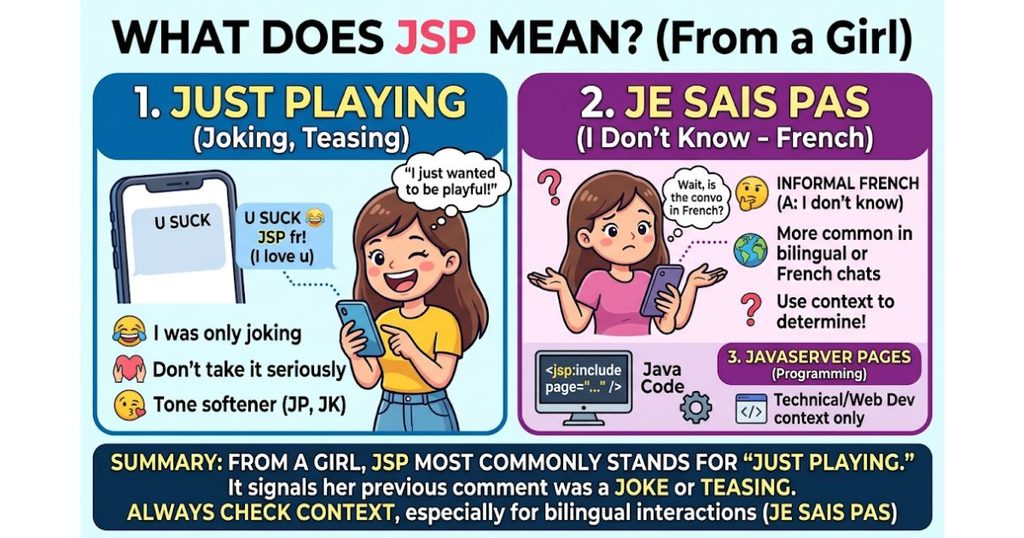
When this term comes from a girl in a texting context, it typically carries the same core meaning softening a joke or tease but can occasionally hint at flirtation depending on the surrounding conversation.
A message like “you’re so annoying, jsp” after playful back-and-forth often signals comfortable, flirty energy rather than genuine annoyance. The abbreviation takes the edge off a tease while keeping the tone light.
As with most slang, tone and emoji use matter more than the words themselves. The same three letters can read as purely platonic joking or something a little more flirtatious, depending on context.
Origin and History of “JSP”
This abbreviation grew alongside the broader rise of SMS and early online chat platforms in the late 2000s, when character limits pushed users to compress common phrases wherever possible.
“Just playing” was already a familiar spoken phrase used to soften teasing before it made the jump to texting shorthand. Shortening it into three letters fit naturally alongside similar terms like JK (Just Kidding).
Its French meaning, “Je Sais Pas,” developed independently and spread through bilingual and international online communities, eventually crossing over into English-language texting through mixed friend groups and social media.
Both versions have coexisted for years without one fully replacing the other, which is part of why context remains essential when reading the term today.
How “JSP” Is Used on Different Platforms
Usage shifts slightly depending on where you see it.
| Platform | Typical Use | Tone |
| TikTok | Comments after teasing or self-deprecating jokes | Playful, light |
| Snapchat | DMs between close friends | Casual, familiar |
| Comment replies or captions | Relaxed, joking | |
| Discord | Gaming chats during fast-paced matches | Quick, functional |
On Discord, this abbreviation sometimes leans toward its French meaning, especially in gaming contexts where players quickly admit they don’t know an answer or location mid-match.
JSP in Texting vs. Real Life
This is a written term first, built for typing rather than speaking. Saying “J-S-P” out loud sounds unnatural, and almost nobody actually speaks the abbreviation itself.
In texting, it works as a quick tone-clarifier, letting someone soften a joke or admit uncertainty in three characters instead of a full sentence.
In real life, people either say the full English phrase “I was just playing” or, if using the French meaning, say “je sais pas” aloud instead of spelling out the letters.
This mirrors most texting slang. It solves a written-tone problem that doesn’t exist the same way in face-to-face conversation, where body language and voice already communicate intent.
Examples of “JSP” in Sentences
Seeing the term across different contexts makes the pattern easier to recognize.
Softening a tease:
- “You really thought that was true? jsp.”
- “Deleting your number rn, jsp.”
Self-deprecating humor:
- “Tripped in front of everyone today, jsp.”
- “Forgot the meeting again, jsp lol.”
French “I don’t know” usage:
- “Are we still meeting up? jsp yet.”
- “What’s the answer to number four? jsp.”
Gaming/Discord context:
- “Where did he go? jsp.”
Each example shows how the same three letters shift meaning depending on whether a joke or a genuine question came before it.
Variations and Related Slang
This abbreviation belongs to a family of short texting terms used to clarify tone or admit uncertainty.
| Term | Meaning | How It Differs |
| JSP | Just Playing / Je Sais Pas | Dual meaning, context-dependent |
| JK | Just Kidding | Nearly identical to the English meaning |
| JS | Just Saying | Softer, without the playful/joking element |
| IDK | I Don’t Know | English equivalent of the French meaning |
| LOL | Laughing Out Loud | General humor marker, less tone-specific |
JK is the closest match to the English meaning, while IDK covers the same ground as the French “I don’t know” usage without needing bilingual context.
Why Tone-Clarifying Slang Like JSP Matters in Texting
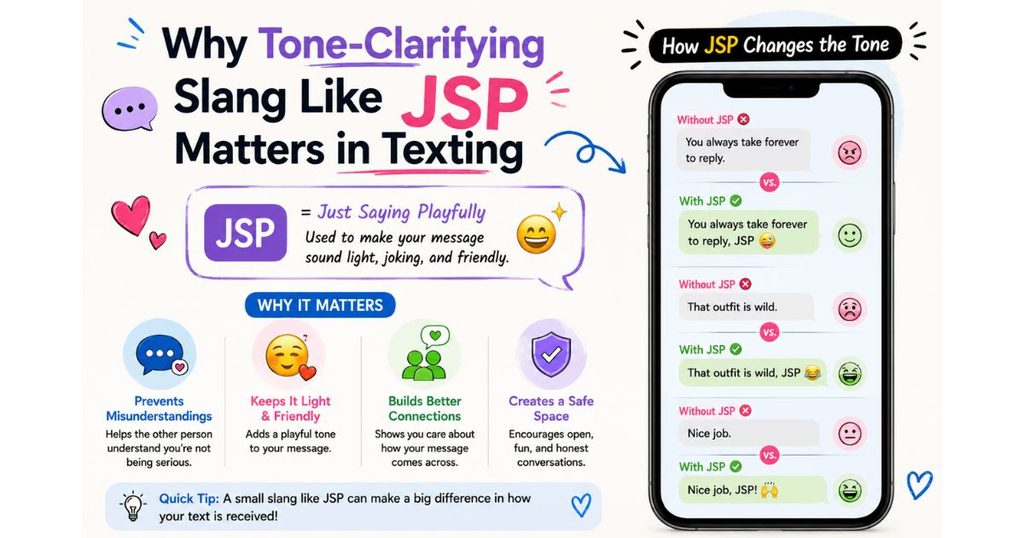
Text messages strip away tone of voice, facial expressions, and body language, which makes jokes easy to misread as genuine complaints or insults. Terms like this one exist specifically to fill that gap.
Adding a short tag after a joke acts as a written cue that says “this was all in good fun,” preventing unnecessary hurt feelings or awkward back-and-forth clarifications.
This function explains why the term has stuck around for years rather than fading like more purely aesthetic slang trends, since it solves a real communication problem rather than existing for style alone.
How French Slang Like JSP Crosses Into English Texting
The French meaning of this abbreviation is a good example of how digital slang increasingly borrows across languages. Teens and young adults exposed to international content on TikTok and Discord frequently pick up short, useful phrases from other languages.
“Je sais pas” fits naturally into fast-paced texting because it’s short, functional, and easy to type even for non-French speakers once they learn the abbreviation.
This kind of cross-language borrowing is becoming more common generally, as global platforms mix audiences who casually pick up each other’s shorthand through everyday interaction rather than formal language learning.
Is “JSP” Safe for Kids?
Yes. This is a harmless, commonly used slang term with no hidden or inappropriate meaning in either its English or French usage.
- It’s typically used to soften a joke or admit uncertainty.
- It carries no aggressive or adult undertone in casual use.
- It’s common in everyday teen and tween texting.
- Parents and teachers have no strong reason to flag it.
The only situation worth a gentle conversation is if a joke tagged with this term still comes across as hurtful — that’s a tone issue between friends, not something caused by the abbreviation itself.
When to Use (and Avoid) “JSP”
Good times to use it:
- Softening a joke or playful tease with a friend
- Admitting you don’t know something in a casual chat
- Reacting to your own mistake with light humor
- Keeping a fast-paced group chat relaxed
Times to skip it:
- Formal emails or professional messages
- Serious or emotional conversations
- Academic or workplace communication
- Situations where the joke could still come across as hurtful
As with most texting slang, reading the room matters more than the abbreviation itself.
Frequently Asked Questions
What does JSP mean in a text?
JSP most commonly means “Just Playing,” used to soften a joke or tease in casual texting.
Can JSP mean something else?
Yes, JSP can also mean “Je Sais Pas,” French for “I don’t know,” depending on context.
Is JSP the same as JK?
They’re very similar, though JK specifically means “Just Kidding” without the French alternative meaning.
Do people say JSP out loud?
No, people typically say the full phrase instead of speaking the abbreviated letters.
Is JSP rude to use?
No, it’s meant to soften a message, though tone still matters depending on the joke.
Is JSP appropriate for work messages?
No. Like most casual slang, it doesn’t belong in formal emails or professional communication.
How do I know which JSP meaning someone means?
Check what came before it — a joke usually means “just playing,” while a question usually means “I don’t know.”
Conclusion
JSP is a flexible piece of texting slang that most often means “Just Playing,” used to soften a joke or tease, though it can also mean “Je Sais Pas” in French-influenced conversations. It’s common across TikTok, Snapchat, and Discord, almost always typed rather than spoken.
Whether you’re using it to lighten the mood or admit you’re unsure, this abbreviation is easy to use once you know how to read the context around it.
