
Two letters. Endless confusion. If you have ever stared at a message wondering what “FW” actually means, you are not alone. This tiny abbreviation shows up everywhere email subject lines, Instagram captions, TikTok comments, WhatsApp threads and it does not always mean the same thing. The key is context, and once you understand it, FW becomes one of the easiest pieces of modern digital language to read.
This guide covers every angle: the slang version, the professional version, real conversation examples, cultural roots, and smart ways to reply. Whether you are new to texting culture or just filling in a gap, you will leave with complete clarity on what FW means in any situation.
FW Meaning at a Glance: The Two Definitions You Need to Know
FW carries two very different meanings depending on where it appears:
FW = F*ck With (slang: to like, support, approve of, or vibe with someone or something)
FW = Forward (professional: passing along an email or message to another recipient)
These two meanings almost never overlap in practice. The platform and tone of the conversation immediately tell you which one applies.
Simple Definitions:
- FW (slang) means you like, support, or feel connected to something
- FW (email) means you are forwarding a message to someone else
Example Uses:
- “I fw that new album so hard.” (slang approval)
- “I don’t fw drama.” (slang setting a boundary)
- “FW: Updated Project Timeline” (email forwarded message)
- “Can you fw this to the team?” (professional request to forward)
The same two letters. Completely different worlds.
Where FW Comes From: Origin and Background of the Term
FW as “Forward” in Professional Communication
The email version of FW has a straightforward history. When email became standard in the 1990s, email clients automatically placed “FW:” or “FWD:” in the subject line whenever a user forwarded a message. It became universal shorthand in workplaces almost overnight. Today it remains a standard professional convention recognized globally across every major email platform.
FW as “F*ck With” in Slang Culture
The slang version has a richer and more culturally significant origin. The phrase “f*ck with” has roots in African American Vernacular English (AAVE), where it was used for decades to express loyalty, trust, and connection. In hip-hop culture, artists used it in lyrics to signal who they respected or associated with. When a well-known rapper said they “fw” a particular brand or person, it was a high endorsement.
As social media grew through the 2010s, texting culture favored shorter expressions. “F*ck with” naturally compressed into FW. Platforms like Twitter, Instagram, TikTok, and Snapchat accelerated its spread into mainstream digital language. Today it is widely understood among Gen Z and Millennials, and its meaning has softened considerably. What once carried an edgy tone is now often simply a casual way to say “I like this.”
Real-Life Conversations: How People Actually Use FW Every Day
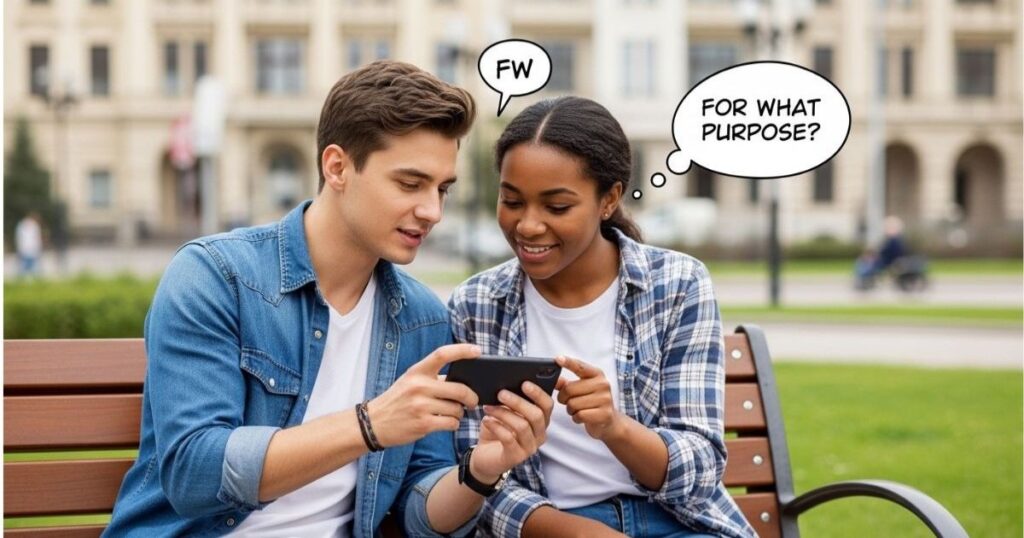
Reading FW in context is the fastest way to understand it. Here are authentic examples across different platforms:
- WhatsApp Chat
Person A: You still fw that gym? Person B: Yeah, heavy. Trainers are solid.
Here FW means continued support or liking.
- Instagram DM
Person A: You fw this fit or nah? Person B: I fw it. Clean and simple.
Here it signals approval of an outfit.
- Email at Work
Subject: FW: Client Proposal Draft
No slang involved. This simply means someone forwarded the email.
- TikTok Comment
User1: Not everyone gonna fw your growth. User2: Real talk.
Here FW means “support” — not everyone will cheer for your progress.
- Snapchat DM
“Lowkey fw this song though, don’t judge me.”
Here “lowkey fw” means quietly liking something, almost as an admission.
Each example shows the same abbreviation doing different emotional work depending on the space it lives in.
The Emotional Weight Behind FW Slang
FW is not just casual chat. In modern digital communication, short phrases carry surprisingly deep social meaning. When someone says “I fw you,” they are offering trust. When someone says “I don’t fw fake people,” they are drawing a clear personal boundary.
This slang often signals:
- Approval and validation: “I fw your energy” tells someone their presence is appreciated
- Loyalty and belonging: Using FW to describe a person often implies ongoing support
- Selective identity: Who and what you fw reflects your values and taste
- Boundary-setting: “I don’t fw that” is a polite but firm way to disengage
In online culture where emotional expression happens fast, FW packs a lot of meaning into two characters. It is emotional shorthand quick, direct, and loaded.
How FW Is Used Across Different Platforms and Contexts
- Social Media (TikTok, Instagram, Twitter/X)
FW shows up constantly in captions and comments. “Y’all fw this drop?” is a creator asking their audience for support. “I only fw good vibes” signals a personal brand. The tone is casual, expressive, and trend-driven.
- Friends and Personal Relationships
Among close friends, FW is used to express attraction, loyalty, dislike, or approval. “I fw her, she’s real” is genuine praise. “I stopped fwing him after that” signals a relationship shift. It is personal and boundary-setting in nature.
- Work and Professional Settings
Only one meaning applies here: Forward. FW should never appear as slang in workplace communication. Writing “I fw your proposal” in an email would be confusing and unprofessional. Stick to “FW:” only in subject lines or explicit forwarding requests.
- Casual Versus Serious Tone
The same abbreviation can be light or heavy depending on sentence context:
- Light: “I fw that meme, lol.”
- Heavy: “I don’t fw dishonesty at all.”
Reading the emotional energy of the full sentence matters more than the letters themselves.
Common Misunderstandings About FW
Assuming it always means “Forward”
On social media and in personal texts, FW almost never means Forward. If a friend says “I fw that,” they are not asking you to send anything.
Thinking it is always aggressive or offensive
Even though its roots contain profanity, modern FW slang is usually friendly and casual. “I fw you” is a compliment in most conversations.
Using it in professional emails
Never write “I fw your idea” to a colleague or manager. The slang version has no place in formal communication. Use it only to mean Forward in subject lines.
Misreading the tone
“I don’t fw you” can range from playful teasing to a genuine warning depending on tone, context, and the relationship. Always read the full message before reacting.
FW vs. Similar Slang Terms: A Quick Comparison
| Term | Meaning | Tone | Common Context |
| FW | Like / Support | Casual | Texting, social media |
| Forward | Pass along message | Professional | |
| Rock With | Strongly support | Slang | Youth culture |
| FWM | F*ck With Me | Casual invite | Social media |
| FWIW | For What It’s Worth | Neutral | Texting, forums |
| Cap / No Cap | Lie / No Lie | Gen Z slang | TikTok, Twitter |
10 Common FW Variations You Will See in Real Conversations
- FW Heavy Strong support: “I fw that idea heavy.”
- Don’t FW With Disassociation: “I don’t fw negativity.”
- FW Somebody Liking a person: “She fw him for sure.”
- FW Something Approving content: “I fw this playlist.”
- Still FW Ongoing loyalty: “You still fw them?”
- Lowkey FW Quiet approval: “Lowkey fw that vibe.”
- Highkey FW Open approval: “Highkey fw her confidence.”
- FW Energy Matching vibe: “We fw the same energy.”
- Who You FW? Social identity: asking who someone associates with
- Why You FW Me? Can mean teasing or mild annoyance depending on tone
How to Respond When Someone Uses FW
Casual Replies
- “Yeah, I fw it too.”
- “Not really my vibe, but I see it.”
- “Heavy!”
Funny Replies
- “I fw it like it owes me money.”
- “Only on Fridays.”
Mature / Confident Replies
- “I respect that, not for me though.”
- “Appreciate that, means a lot.”
Warm / Affirming Replies
- “Same, I fw your energy too.”
- “That actually means a lot, thank you.”
Matching the emotional register of the conversation keeps things natural. Do not overthink a casual “I fw it” with a lengthy response.
FW Across Generations: Who Uses It and How
Understanding FW also means understanding who is using it and why the same two letters can land differently across age groups.
| Generation | Typical Interpretation | Comfort Level |
| Gen Alpha (born 2010+) | Slang, natural digital language | Very High |
| Gen Z (1997-2012) | Primary slang users, very fluent | Very High |
| Millennials (1981-1996) | Comfortable with both meanings | High |
| Gen X (1965-1980) | Mostly associates with email Forward | Moderate |
| Boomers (1946-1964) | Almost exclusively email Forward | Low |
This generational gap is exactly why misunderstandings happen. A Millennial texting their Gen X parent “I fw your idea” might get a very puzzled reply.
Why FW Spread So Fast: The Psychology of Slang Adoption
Language shortcuts thrive when they are efficient, expressive, and culturally backed. FW checks all three boxes. It saves characters in environments with limits or fast-paced exchanges. It carries cultural credibility through its roots in hip-hop and AAVE. And it is flexible enough to express approval, loyalty, or rejection depending on a single extra word.
Social media algorithms also play a role. Once FW appeared in viral TikTok captions and Instagram posts, millions of users adopted it organically. Meme culture reinforced it. Rap lyrics kept it alive. The combination of speed, cultural weight, and digital amplification turned a two-letter phrase into a globally recognized shorthand. This is how modern internet slang earns its place in everyday conversation — not by dictionary entry, but by repetition across millions of screens.
Regional and Cultural Use of FW Around the World
Western Culture (especially the US)
FW slang is most deeply embedded in American youth culture. It entered mainstream communication through hip-hop, and today it is standard among younger demographics across the country.
Asian and Global English Communities
Among English-speaking youth in Asia and globally, FW circulates primarily through TikTok and Instagram. It is more common online than in offline or formal settings.
Middle Eastern and Other Regions
FW appears mainly in globalized digital spaces. Traditional or offline communication in these regions rarely uses it. Cultural sensitivity matters when using slang across language and cultural barriers.
The Global Digital Layer
Thanks to TikTok’s international reach, FW has crossed many borders. However, the professional “Forward” meaning remains the safer and more universally recognized version for cross-cultural formal communication.
Frequently Asked Questions
What does FW mean in a text message?
FW usually means “f*ck with” in texting slang, meaning to like, support, or vibe with someone or something.
Is FW rude or offensive?
Not in most cases. Despite its origin, modern slang usage of FW is typically casual and friendly in tone.
What does “I fw you” mean?
It means the person likes you, respects you, or feels positively connected to you. Context determines whether it is platonic or romantic.
Can I use FW in a work email?
Only to mean “Forward” in a subject line. The slang version is inappropriate in professional communication.
What does “I don’t fw that” mean?
It means the person dislikes something, wants nothing to do with it, or is setting a personal boundary around it.
What is the difference between FW and FWD?
Both mean Forward in email contexts. FW is shorter and more common in casual forwarding, while FWD appears in some email clients automatically.
Where did FW slang come from?
It comes from AAVE and hip-hop culture, where “f*ck with” expressed loyalty and connection. It moved into mainstream digital slang through social media and rap lyrics.
Final Thoughts
FW is a small abbreviation with a surprisingly large range. In professional emails, it simply routes messages. In personal texts and social media, it carries approval, loyalty, connection, or rejection depending on how it is built into a sentence. The meaning you need is almost always sitting right there in the context around it.
Language evolves constantly, and FW is proof that the most powerful expressions are often the shortest ones. Now that you understand every side of it, two letters will never leave you second-guessing again.
