
If you scroll through Reddit, TikTok, or group chats and keep seeing “AITA,” you’re not alone in wondering what it actually stands for. Millions of Gen Z users type it daily without knowing where it came from, why it caught on, or how a single 2013 subreddit turned into a global internet format.
This guide breaks down every meaning of the term, from its viral Reddit origin to unrelated word meanings found in completely different languages.
We’ll cover the full verdict system, real examples across situations, the psychology behind its popularity, and how the phrase spread across every major platform. By the end, you’ll understand AITA better than most people who use it every single day.
What Does AITA Mean?
AITA stands for “Am I The Asshole,” a phrase used to ask other people to judge whether you behaved badly in a real-life conflict. It started as a Reddit acronym and has since become common internet shorthand across nearly every social platform, from casual texts to full video storytimes.
People post a situation, and the community responds with a verdict. It’s become a form of crowdsourced moral judgment that Gen Z and millennials use constantly, both online and offline, often replacing the need to ask a friend for a second opinion.
The appeal lies in its simplicity. Instead of a long, back-and-forth conversation about who was right, AITA compresses an entire dispute into a single question and a handful of short, decisive replies. That efficiency is a big reason the format has outlasted countless other internet trends.
Core Definition:
- Full form: Am I The Asshole
- Used as: A question, a subreddit name, and a full genre of storytelling post
- Purpose: To get an outside, honest opinion on a personal conflict from strangers
- Tone: Blunt, casual, often self-deprecating, and rarely sugarcoated
- Platforms: Originated on Reddit, now common across TikTok, Instagram, and texting
Origin and History of AITA
The subreddit r/AmITheAsshole was created in June 2013 by a Reddit user known as flignir, a photographer who wanted outside opinions on a workplace thermostat dispute with female coworkers. No existing subreddit allowed that kind of post, so he built his own rather than force his question into a community that wasn’t designed for it.
The forum grew slowly at first, staying a niche corner of Reddit for several years. Growth accelerated through the late 2010s as more users discovered the format and started sharing posts outside the platform. By October 2023, the subreddit had passed 11.4 million subscribers, making it one of Reddit’s largest and most active communities.
A major turning point came when the moderation team introduced an automated bot that tallies votes 24 hours after posting and assigns an official verdict. This structure turned a simple question into a repeatable, predictable format that spread far beyond Reddit itself.
Strict community rules also played a role in the subreddit’s longevity. Moderators enforce civility rules that discourage personal attacks, which helped AITA avoid the toxicity that eventually sank several other anonymous confession platforms of the same era.
Aita meaning tourism
In travel and tourism contexts, “AITA” is sometimes used as shorthand for regional tourism associations or travel-related organizations, and the acronym can vary significantly depending on the country or industry using it.
Because this usage is niche and industry-specific, it rarely overlaps with everyday searches. Someone typing “AITA” while browsing travel content is far more likely to have stumbled onto the term through an unrelated search than through genuine familiarity with a tourism body.
Unlike the Reddit meaning, there is no single, globally standardized “AITA” tourism body, so the acronym should always be confirmed against the specific organization or region being referenced before assuming what it stands for.
Aita meaning euskera
In Euskera, the Basque language spoken in northern Spain and southwestern France, “aita” simply means “father.” It is a common, everyday word used the same way “dad” or “papa” is used in English, appearing frequently in family conversation and regional media.
This meaning has nothing to do with the Reddit acronym. The spelling overlap is entirely coincidental, since Basque is one of Europe’s oldest languages and predates the internet slang term by many centuries.
Basque itself is a language isolate, meaning it isn’t related to Spanish, French, or any other major European language family. Words like “aita” reflect that unique linguistic history rather than any connection to modern internet culture.
What does aita mean in english
There is no direct English word called “aita.” When people search this, they usually mean one of two things: either the Basque word for “father,” or the internet acronym AITA, which stands for “Am I The Asshole.”
Context determines the correct meaning. If it appears in lowercase within a sentence about family, culture, or language, it most likely refers to the Basque word. If capitalized in a social media caption or comment section, it almost always refers to the Reddit-style question instead.
Translation tools sometimes struggle with this ambiguity, since they can’t always tell whether a user wants a literal word translation or an explanation of internet slang. Reading the surrounding sentence usually clears up the confusion instantly.
Aita meaning japanese
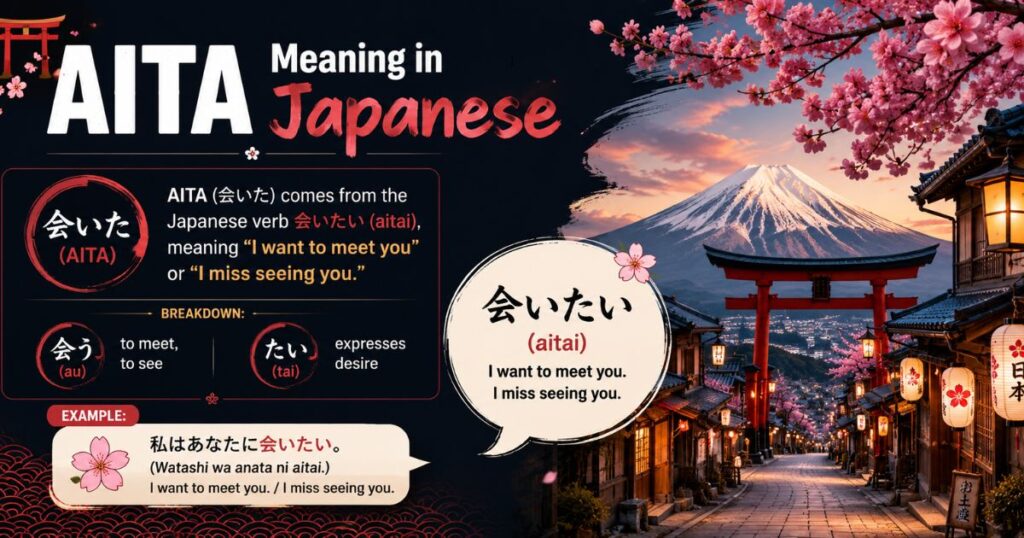
“Aita” is not a standard, common Japanese word with an independent dictionary meaning, though it can appear as a Japanese surname when romanized into the Latin alphabet. It is not related to the Reddit acronym or the Basque word for father.
If you saw “aita” used in a Japanese context, such as a name in a show, article, or credits list, it was most likely a personal or family name rather than a translated term carrying independent meaning.
Romanization can create confusing overlaps like this, where unrelated words from completely different language families end up looking identical once written in the same alphabet.
Aita meaning Finnish
In Finnish, “aita” translates to “fence.” It’s a straightforward, literal noun used in everyday conversation about property boundaries, gardens, or enclosures, and appears often in rural and suburban contexts.
Like the Basque and Japanese examples, this meaning is entirely unrelated to the Reddit acronym. The similarity in spelling across languages is a linguistic coincidence, not a shared origin or borrowed term.
Finnish, much like Basque, is not part of the same language family as English or the Romance languages, which is part of why such spelling overlaps happen despite zero historical connection.
What does aita mean in spanish
Spanish itself does not have a native word “aita” in standard, nationwide usage, but the term appears in Spain’s Basque-influenced regions where Euskera and Spanish overlap in daily life. In those bilingual areas, “aita” retains its original Basque meaning of “father.”
Outside of Basque-speaking regions, most Spanish speakers typically wouldn’t recognize “aita” as a standard word unless referencing the internet acronym, a regional dialect, or a personal name.
This regional variation is a good reminder that a single country’s language can contain multiple, sometimes unrelated vocabularies depending on which community or region is speaking.
The Complete AITA Verdict System
Reddit’s AITA format runs on a small set of standardized verdicts. These labels appear as bolded top comments and eventually get applied to the post itself by an automated bot once enough votes come in.
This system works because it forces commenters into clear categories instead of vague opinions. Readers scanning a post can instantly see which side the community leans toward, even without reading every comment in the thread.
| Verdict | Meaning | What It Signals |
| YTA | You’re The Asshole | The poster was in the wrong |
| NTA | Not The Asshole | The poster acted reasonably |
| ESH | Everyone Sucks Here | Both sides behaved badly |
| NAH | No Assholes Here | Neither side did anything wrong |
| INFO | Not Enough Info | More details are needed to judge |
When Each Verdict Gets Used:
- YTA is used when the poster clearly escalated, lied, or ignored reasonable boundaries set by another person.
- NTA is the most common verdict, often reflecting the poster’s own framing of the events they shared.
- ESH applies to messy situations where both parties handled things poorly and share meaningful blame.
- NAH fits genuine misunderstandings where no one acted maliciously or unreasonably.
- INFO is used when key context is missing, like timelines, prior history, or details left out of the original post.
Commenters typically read the full post before voting, and top-voted comments explaining the reasoning behind a verdict tend to shape how later readers interpret the situation.
Real AITA Examples Across Different Situations
Understanding AITA is easier through examples. Below are short, realistic scenarios showing how the format plays out across very different types of conflict, from serious family issues to casual, low-stakes disagreements.
Example 1: Family Conflict
“AITA for refusing to host Thanksgiving after my sibling hosted it badly last year?” This kind of post usually draws mixed verdicts depending on the family history shared in the comments, since family disputes rarely have a clean, obvious answer.
Example 2: Friend Group Drama
“AITA for leaving a group chat after being left out of a trip?” These posts often split between NTA and ESH, depending on how the exclusion happened and whether it was intentional or accidental.
Example 3: Workplace Situation
“AITA for reporting a coworker who kept taking credit for my work?” Workplace posts tend to lean NTA when documentation or witnesses are involved, since verifiable proof strengthens the poster’s case significantly.
Example 4: Everyday Decision
“AITA for not splitting a restaurant bill evenly when I only had water?” Small, low-stakes posts like this are extremely common and usually get quick, decisive verdicts within the first few comments.
Example 5: Relationship Conflict
“AITA for checking my partner’s phone after finding suspicious texts?” These posts generate long debates about trust, privacy, and prior context, often becoming some of the most-commented threads on the subreddit.
Example 6: Casual Joking Use
Not every AITA is a real Reddit post. Friends often text “AITA?” jokingly after a minor disagreement, using the format as shorthand rather than actually posting anywhere for judgment.
Example 7: Text Conversation
A group chat message like “AITA for muting my roommate’s alarm three times?” shows how the phrase has become a casual conversational tool, not just a Reddit genre reserved for major life conflicts.
How AITA Is Used Beyond Reddit
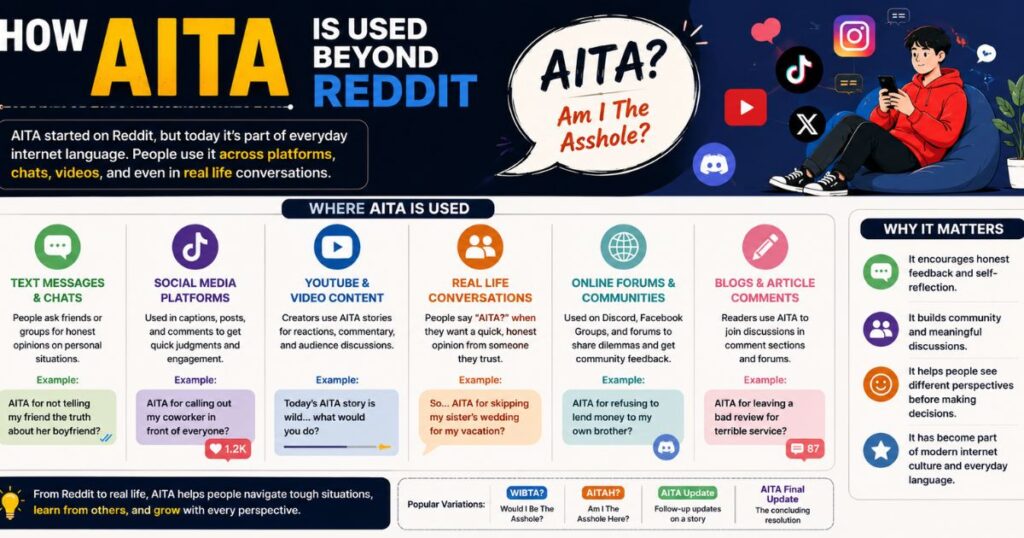
AITA has moved far past its original subreddit. It’s now a recognizable format across nearly every major social platform, often reused as a content style rather than a literal question, and adapted to fit each platform’s format.
Creators post AITA-style captions on relationship or friendship content to invite comment-section debate, boosting engagement through controversy and encouraging followers to weigh in publicly.
TikTok
TikTok has an entire niche of AITA storytime videos, where creators narrate conflicts and ask viewers to vote in the comments or via built-in polls, often turning a single story into a multi-part series.
Twitter and X
Users post short AITA threads, often exaggerated for comedic effect, generating quote-tweet debates similar to Reddit’s comment threads but moving much faster due to the platform’s real-time nature.
WhatsApp and iMessage
In private chats, “AITA” is used casually between friends to get quick opinions on small disputes, without any formal posting involved, functioning more like a shared inside joke than a genre.
Snapchat
Snap stories sometimes feature quick AITA-style polls, letting close friends vote using built-in sticker features for instant, informal feedback on minor everyday decisions.
Discord
Server communities run dedicated AITA channels where members post conflicts for peer judgment, mimicking Reddit’s structure in a smaller, closer group where members already know each other’s context.
The Psychology Behind Why People Love AITA
AITA’s popularity isn’t random. It taps into several deep psychological needs that make it addictive to both post and read, which explains why the format has stayed relevant for over a decade.
1. The Need for Validation
Posters often already believe they’re right and want the comment section to confirm it, providing a sense of external validation that’s hard to get from people who already know all the context.
2. The Appeal of Judgment
Readers enjoy forming quick moral opinions about strangers. AITA offers a low-stakes way to judge other people’s choices without any real-world consequences attached to that judgment.
3. Moral Clarity in a Complex World
Real life is messy, but AITA distills conflict into a simple verdict, offering satisfying clarity that everyday disputes rarely provide outside of the subreddit’s structured format.
4. Connection Through Shared Experience
Reading about relatable conflicts helps people feel less alone in their own frustrating situations, even if they never post themselves or comment on a single thread.
5. Safe Space for Moral Learning
Some readers use AITA to reflect on their own behavior patterns, learning from other people’s mistakes without any personal risk, embarrassment, or real-life fallout involved.
Why AITA Went Viral So Quickly
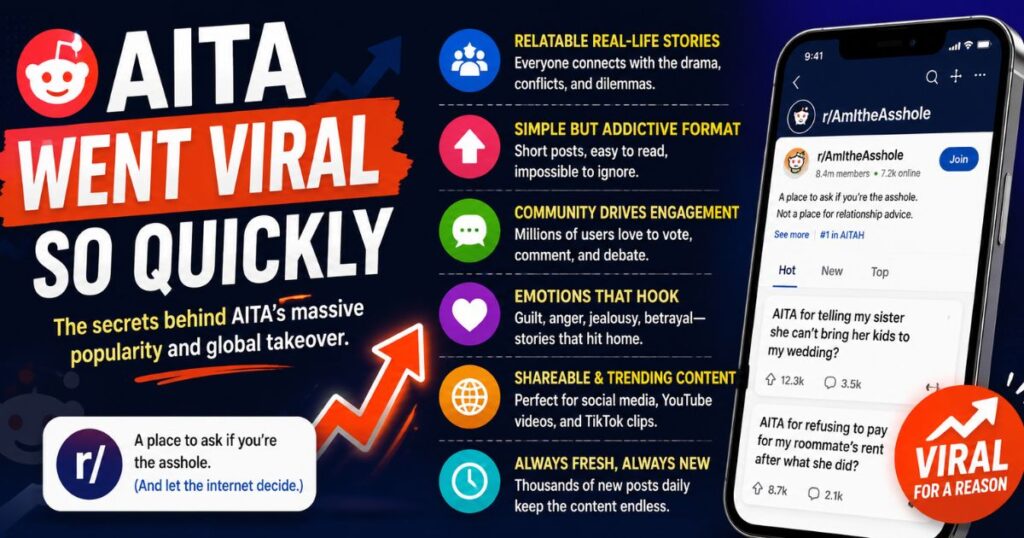
AITA spread quickly because it combined storytelling, drama, and interactivity into one simple, repeatable format. Unlike passive content, it invites direct participation through voting and commenting, which keeps readers engaged far longer than a typical post.
Celebrity attention accelerated this further; a widely shared tweet from Chrissy Teigen about binge-reading the subreddit introduced it to a much larger mainstream audience almost overnight. Media outlets and podcasts followed, cementing AITA as recognizable internet culture rather than a niche Reddit habit known only to longtime users.
The format’s low barrier to entry also mattered. Anyone can write a post without special skills, and anyone can leave a one-line verdict, which meant participation never required much effort from either side.
How to Write a Good AITA Post
Writing a post that gets a fair, accurate verdict takes more thought than it seems. The best posts follow a clear, consistent structure that gives readers everything they need.
- State the situation clearly at the start, avoiding excessive backstory before the actual conflict is introduced.
- Include relevant context, like prior arguments, specific promises made, or relevant history between the people involved.
- Be honest about your own actions, even the parts that make you look bad, since selective honesty usually gets called out quickly.
- Avoid dramatic exaggeration, since experienced readers can usually tell when details feel inflated or added purely for sympathy.
- End with a clear, direct question, such as “AITA for saying no?” so commenters know exactly what they’re judging.
What NOT to Do When Using AITA
Just as important as writing a good post is avoiding common mistakes that undermine the entire point of asking.
- Don’t leave out key details that would obviously change the verdict, since this only delays an accurate judgment.
- Don’t use it to publicly shame a specific, identifiable person without their knowledge or consent, which crosses into real harm.
- Don’t post fabricated stories purely for engagement, since this undermines the format’s credibility for everyone else using it.
- Don’t ignore the verdict just because it wasn’t the answer you wanted to hear in the first place.
AITA in Meme Culture
AITA has become a meme template far beyond its original text-post format. Screenshots of dramatic AITA titles are shared purely for comedic shock value, often stripped of any real context and posted just for the absurdity of the headline alone.
Parody accounts post intentionally absurd AITA scenarios, exaggerating petty conflicts to ridiculous extremes purely for entertainment. The phrase itself is now used sarcastically in captions unrelated to any real conflict, purely as a joke about petty or overly dramatic behavior.
This meme usage has arguably done as much to spread AITA as the original subreddit content, since jokes and screenshots travel further and faster than long-form posts ever could.
AITA Variations You Should Know
Over time, several spinoff terms and communities developed around the original AITA format, each with a slightly different focus or tone.
| Variation | Meaning |
| WIBTA | Would I Be The Asshole (asking before taking an action) |
| AITAH | Am I The Asshole Here (a larger, less strict spinoff subreddit) |
| TIFU | Today I F***ed Up (a related confession format) |
| relationship_advice | A related subreddit for ongoing relationship issues |
WIBTA is especially useful because it lets people ask for judgment before acting, rather than after the conflict has already happened. This preventative version has become popular for major decisions like moving out, cutting off a friend, or skipping a family event.
AITAH emerged partly because the original subreddit’s rules became stricter over time, prompting some users to seek a less moderated space with looser posting requirements.
AITA vs Similar Internet Formats
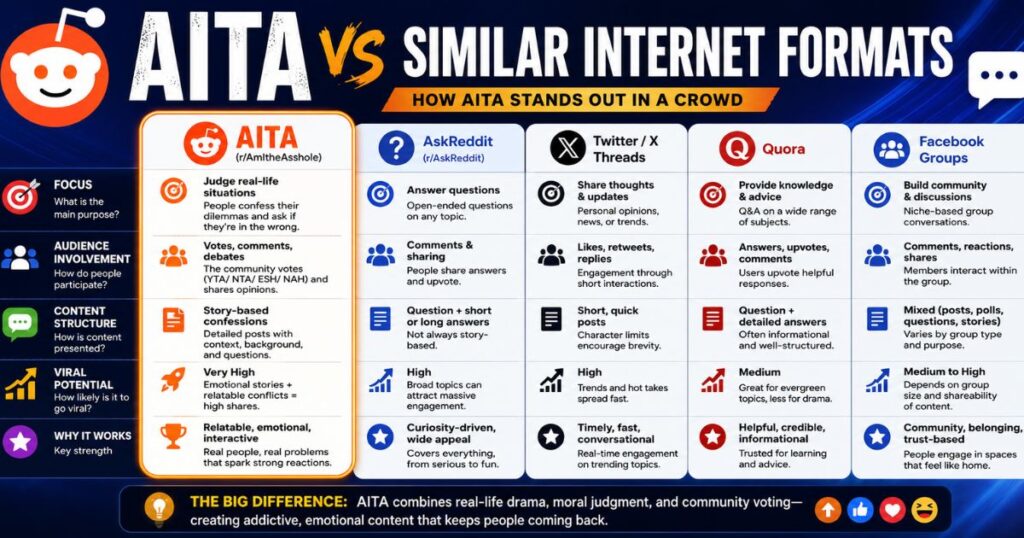
AITA isn’t the only confessional or judgment-based format on the internet, and understanding how it differs from similar communities helps clarify exactly what makes it unique.
| Format | Purpose | Key Difference |
| AITA | Judge a specific conflict | Focused on right/wrong verdicts |
| TIFU | Share a personal mistake | No judgment system, just storytelling |
| Am I Overreacting | Gauge emotional proportionality | Focuses on reaction, not blame |
| Relationship Advice | Get guidance going forward | Solution-focused, not verdict-focused |
The biggest difference is intent. AITA exists specifically to assign blame through a structured verdict, while formats like Relationship Advice focus on solving a problem rather than deciding who was wrong in the first place. TIFU, meanwhile, skips judgment entirely and simply invites reactions to a personal story.
Common Misconceptions About AITA
A few myths about AITA persist even among regular users, and clearing them up helps explain why the format works the way it does.
- Myth: Verdicts are decided by moderators. In reality, verdicts come from community voting, with an automated bot simply tallying results after a set time window.
- Myth: Every post is completely true. Some posts are exaggerated or entirely fabricated for engagement, which is why experienced readers stay skeptical of dramatic details.
- Myth: NTA always means the poster was actually right. It only reflects majority opinion among commenters, not an objective, verified fact.
- Myth: AITA is only for serious conflicts. Many popular posts involve trivial, low-stakes situations, since relatability matters more than severity.
- Myth: The format is unique to Reddit. As covered earlier, AITA-style judgment now exists natively across TikTok, Discord, and private messaging.
Understanding these distinctions helps new users approach the format with realistic expectations rather than treating every verdict as an absolute, courtroom-style ruling.
Quick Reference Summary
For anyone who wants the short version without scrolling back through the full guide, here’s everything condensed into one place.
- AITA = “Am I The Asshole,” a Reddit-born judgment format created in 2013.
- The subreddit launched in June 2013 and now has over 11 million subscribers.
- Verdicts include YTA, NTA, ESH, NAH, and INFO, each signaling a different level of blame.
- Unrelated word meanings exist in Basque (father), Finnish (fence), and as a Japanese surname.
- The format has spread well beyond Reddit to TikTok, Instagram, Discord, and everyday texting between friends.
- Spinoff formats like WIBTA and AITAH offer preventative or less strict versions of the same concept.
Keep this section bookmarked if you ever need a fast refresher without rereading the entire breakdown.
Frequently Asked Questions
What does AITA stand for?
AITA stands for “Am I The Asshole,” a phrase used to ask others to judge a personal conflict.
When did the AITA subreddit start?
The subreddit began in June 2013, created by a user known as flignir.
What does NTA mean in AITA posts?
NTA means “Not The Asshole,” indicating the poster acted reasonably in the situation.
Does aita mean something in other languages?
Yes, aita means “father” in Basque and “fence” in Finnish, unrelated to the Reddit acronym.
Is AITA only used on Reddit?
No, it’s now used on TikTok, Instagram, Discord, and in everyday texting between friends.
What is the difference between YTA and ESH?
YTA means only the poster was wrong; ESH means both sides share blame.
Why did AITA become so popular?
It combined relatable drama with interactive judgment, boosted further by viral celebrity attention.
Conclusion
AITA has grown from a single 2013 subreddit into a recognizable internet format used across nearly every major platform, from TikTok storytimes to quick text messages between friends. Its verdict system, built around simple labels like YTA and NTA, offers quick, structured moral judgment that feels satisfying in an otherwise messy world.
Separately, the word “aita” carries entirely unrelated meanings in Basque, Finnish, and other languages, showing how identical spellings can mean completely different things depending on where and how they’re used.
This kind of overlap is common across languages and is a coincidence of spelling rather than any shared history.
Whether you encountered AITA on Reddit, TikTok, in a group chat, or while searching for an unrelated word meaning, you now understand exactly where the term came from, how the verdict system works, and how it’s used across the internet today.
