
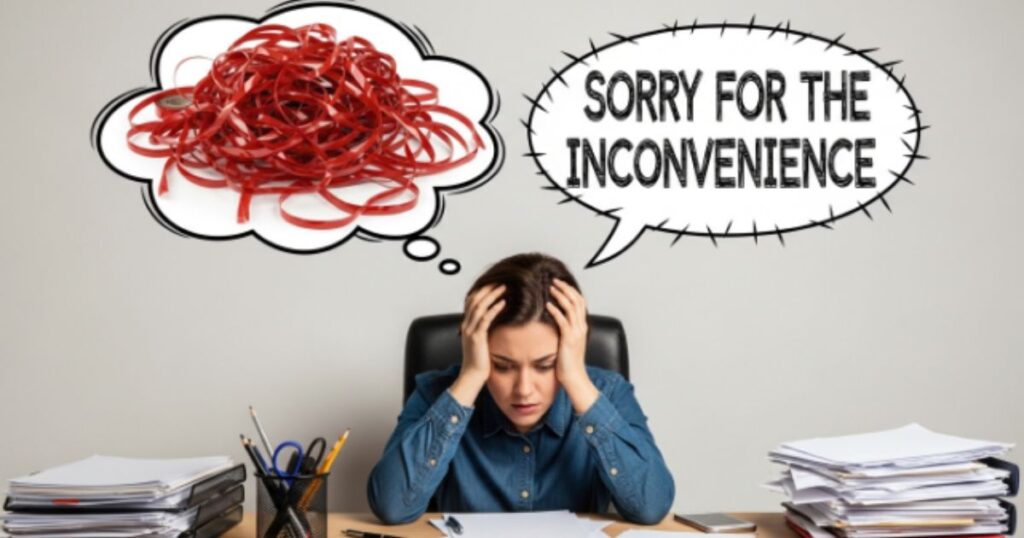
You have seen it in emails, customer service chats, app notifications, and even casual text messages. “Sorry for the inconvenience” is one of the most widely used phrases in both professional and personal communication,yet very few people stop to think about what it actually means or whether it lands the way they intend.
This guide breaks down the full meaning of sorry for the inconvenience, where it came from, how people use it across different platforms, and what to say instead when you want your apology to feel genuine rather than scripted.
Whether you are writing a business email or texting a friend, understanding this phrase will make you a sharper, more empathetic communicator.
Sorry for the Inconvenience Quick Meaning
At its simplest, “sorry for the inconvenience” is a formal apology phrase used to acknowledge that something you did,or failed to do,caused trouble, disruption, or frustration for another person.
Simple Breakdown
The phrase has two working parts. “Sorry” signals remorse or regret. “Inconvenience” refers to any trouble, discomfort, delay, or disruption caused to the other person. Together, they form a polite, general-purpose acknowledgment of wrongdoing without specifying exactly what went wrong.
In Short
It is an all-purpose apology that admits fault without going into detail. In professional settings, it communicates accountability in a neutral, diplomatic tone.
Example Sentences
- “Our website was down for two hours. Sorry for the inconvenience.”
- “Your order will arrive two days late. We are sorry for the inconvenience this may cause.”
- “Sorry for the inconvenience,I completely forgot about our meeting.”
Origin and Background
Where It Started
The phrase traces back to formal written English used in business correspondence throughout the 18th and 19th centuries. In an era when formal letters were the primary mode of professional communication, writers needed polished, universally understood phrases to acknowledge errors without damaging relationships.
How It Evolved
As customer service became an industry in the 20th century, the phrase was adopted into scripts, training manuals, and customer communication templates. It spread because it was safe, inoffensive, and easy to deploy across any situation. Airlines, banks, telecoms, and retailers all adopted it as a default response to complaints.
Modern Influence
In the digital era, the phrase moved into email autoresponders, chatbot scripts, app outage notices, and social media apology posts. This overuse is exactly why it began losing its emotional impact. Research cited by customer service experts found that a genuine apology resolves customer complaints more effectively than compensation alone,yet overuse has turned “sorry for the inconvenience” into a phrase people scroll past without reading.
Real-Life Conversations (MANDATORY)
1. WhatsApp Chat
Riya: Hey, I was waiting at the café for 30 minutes. Sam: Oh no, I completely lost track of time. Sorry for the inconvenience, I should have texted you earlier. Riya: It is fine, just let me know next time.
Here the phrase works because it comes with a specific acknowledgment of what went wrong.
2. Instagram DMs
@customer: My order never arrived and nobody responded to my DM. @brand: Hi! We are so sorry for the inconvenience. Please share your order number and we will sort this out right away.
On social media, brands use this phrase publicly to show responsiveness, though the phrase works better when followed by a clear action step.
3. Text Message
Mia: The reservation got cancelled last minute. Leo: What? Sorry for the inconvenience on our end,I thought I confirmed it. Let me find us somewhere else tonight.
In personal texting, the phrase softens the blow of bad news while signaling that the speaker takes responsibility.
Emotional and Psychological Meaning
What It Communicates
When used sincerely, sorry for the inconvenience communicates three things at once. It acknowledges that something went wrong. It accepts a degree of responsibility. And it signals respect for the other person’s time and experience.
What It Does Not Always Convey
The phrase does not specify what exactly went wrong. It does not explain why it happened. It does not promise it will not happen again. These gaps are exactly why it can feel hollow when used without additional context.
Why People Use It
People reach for this phrase because it is safe. It is socially accepted, professionally neutral, and unlikely to make a situation worse. In customer service, it buys time while a real solution is found. In personal conversations, it bridges awkwardness without requiring full emotional disclosure.
Modern Perception
Research from customer experience studies consistently shows that customers value specificity, empathy, and action over formulaic apology language.
One study found that 45% of customers withdrew negative reviews after receiving a genuine apology, compared to only 23% when offered compensation with no apology. The quality of the apology mattered more than the gesture itself.
Usage in Different Contexts
1. Social Media
On platforms like Twitter/X and Instagram, companies post “sorry for the inconvenience” during service outages, shipping delays, or product issues.
When used publicly, it doubles as reputation management, showing other followers that the brand responds to problems. It works best when paired with a timeline for resolution.
2. Friends and Relationships
Between friends, the phrase is less common because personal apologies typically require more emotional depth. Using “sorry for the inconvenience” with a close friend can actually feel impersonal or dismissive, as if you are treating the relationship like a customer service ticket.
3. Work or Professional Settings
This is where the phrase truly belongs. In business emails, customer service responses, and professional communications, it signals courtesy and accountability without oversharing. A well-crafted professional apology uses this phrase as a starting point, then adds context, explanation, and resolution.
4. Casual vs Serious Tone
In casual situations, a lighter variation like “sorry for the trouble” or “my bad” feels more natural. In serious situations involving real harm or significant disruption, sorry for the inconvenience alone is not enough. The phrase should be a floor, not a ceiling.
Common Misunderstandings
1. It Always Sounds Sincere
It does not. Overuse in automated emails and chatbot scripts has conditioned readers to skim past it. Without context, specificity, or a follow-up action, the phrase reads as a corporate template rather than a human apology.
2. It Works in All Situations
A phrase designed for formal correspondence does not automatically translate to every context. Using it in a deeply personal conversation,for example, after missing an important event in a friend’s life,can feel coldly professional and make the apology land worse than saying nothing at all.
3. It Shows Deep Apology
The phrase shows surface-level acknowledgment, not deep remorse. For situations involving real emotional hurt or significant loss, a more personal, specific, and empathetic apology is required.
When NOT to Use It
Avoid using sorry for the inconvenience in these situations:
- After causing genuine emotional harm to a close friend or partner
- In situations where the affected person needs to hear a specific, detailed acknowledgment of what went wrong
- When you are using it as a way to close a complaint without actually resolving it
- In formal legal or contractual contexts where precise language matters
Comparison Table
| Phrase | Tone | Best Used For | Weakness |
| Sorry for the inconvenience | Formal, neutral | Emails, customer service | Can feel robotic |
| I apologize for the disruption | Formal, accountable | Business communication | Slightly stiff |
| Thank you for your patience | Appreciative | Delays, waiting | Avoids direct apology |
| I regret any confusion caused | Formal, specific | Miscommunications | Vague on fault |
| We’re working on resolving this | Action-oriented | Ongoing issues | Not an apology itself |
| My bad | Casual, honest | Friends, informal | Too informal for business |
| This should not have happened | Accountable, empathetic | Serious errors | Needs follow-up context |
Key Insight
The best apology combines acknowledgment of the specific issue, genuine empathy, and a clear action step. “Sorry for the inconvenience” alone covers only the first part.
Variations and Types
The phrase has several widely used variations, each with a slightly different tone or level of formality. Knowing which to use when makes a real difference in how your apology is received.
- “We apologize for any inconvenience this may have caused”,formal, corporate, often used in email templates
- “We are sorry for the inconvenience and are looking into it now”,combines apology with action, stronger than the base phrase
- “I apologize for the inconvenience”,personal and accountable, preferred in one-to-one professional communication
- “Please accept our apologies for the inconvenience”,very formal, appropriate for official correspondence
- “Sorry for any inconvenience caused”,common British English variant, slightly softer
- “We regret the inconvenience caused”,formal and slightly distant, used in public notices
- “Apologies for the inconvenience”,quick, modern, often seen in app notifications
How to Respond When Someone Uses It
When a company or person says sorry for the inconvenience, your response depends on whether the underlying issue has actually been resolved.
Casual Replies
- “No worries, it happens.”
- “All good, just wanted to flag it.”
- “Thanks for letting me know.”
Funny Replies
- “The inconvenience has been noted and logged.”
- “Accepted. My patience invoice is in the mail.”
- “Apology received. My coffee got cold but we move.”
Mature and Confident Replies
- “I appreciate the acknowledgment. Could you also let me know how this will be prevented going forward?”
- “Thank you. I would just appreciate a resolution as soon as possible.”
- “I understand. Please keep me updated on the fix.”
Private or Respectful Replies
- “Thank you for saying that. It genuinely means a lot.”
- “I really appreciate you reaching out directly.”
- “No need to apologize extensively,just glad it is being addressed.”
Regional and Cultural Usage
Western Culture
In the United States, the United Kingdom, Canada, and Australia, “sorry for the inconvenience” is a staple of business and customer service communication.
British English tends to use it slightly more frequently in everyday speech, as indirect politeness is deeply embedded in communication norms.
Asian Culture
In countries like Japan and South Korea, the concept of apology carries enormous cultural weight and the equivalent of this phrase is used with far more formality and ritual.
A surface-level apology in these cultures can be read as more dismissive than in Western contexts. In India and Pakistan, English-language customer service communication commonly uses the phrase in emails and support tickets.
Middle Eastern Culture
In Arab cultures, apologies are often more elaborate and personal. A short impersonal phrase like “sorry for the inconvenience” may feel abrupt. Longer, more relationship-focused expressions of regret tend to land more warmly in these contexts.
Global Internet Usage
On the internet, the phrase has become borderless. It appears in app update notices, ecommerce shipping emails, airline delay notifications, and social media complaint responses across every language region. Its formal register makes it cross-cultural, though it still lands best when supported by genuine resolution.
When This Phrase Actually Works Well
Despite its overuse, sorry for the inconvenience remains genuinely effective in specific situations. Used correctly, it does real communicative work.
It works best when the disruption was minor and temporary, when you follow it immediately with a concrete solution,
when the other person is a professional contact rather than a close personal relationship, and when your overall communication is warm and specific enough that the phrase does not stand alone as the entire apology.
Used sparingly and paired with empathy and action, the phrase is a perfectly solid tool. The problem has never been the phrase itself,it is the habit of letting it carry the full weight of an apology it was never designed to bear.
Better Alternatives Worth Knowing
If you want your apology to feel fresh and genuine, these phrases make stronger impressions.
| Alternative Phrase | Why It Works Better |
| “I understand how frustrating this must be” | Shows empathy, not just regret |
| “This should not have happened” | Explicitly acknowledges fault |
| “Thank you for your patience while we fix this” | Shifts focus to action and gratitude |
| “I take full responsibility for this” | Personal, accountable, direct |
| “We are making this right immediately” | Outcome-focused, reassuring |
Frequently Asked Questions
Is “sorry for the inconvenience” polite?
Yes, it is polite and professionally appropriate, but it works best when paired with context, empathy, and a clear resolution rather than used on its own.
Is it too formal for everyday use?
In casual conversations between friends or family, it can sound stiff and impersonal. Phrases like “my bad” or “sorry for the trouble” feel more natural in those settings.
Does it sound sincere?
It can, but only when used sparingly and backed by specifics. Overuse in automated messages has made it easy for people to perceive it as hollow filler language.
What is a better alternative?
“I understand how frustrating this must have been” combined with a specific resolution is consistently more effective than the standard phrase used alone.
Can I use it in emails?
Absolutely. It remains one of the most accepted and professionally appropriate phrases for business emails, especially in customer service and client communications.
Is it appropriate for personal apologies?
For minor personal issues it works fine, but for deeper emotional situations it falls short. A more specific, heartfelt acknowledgment is usually needed.
Why do companies use it so much?
Because it is safe, neutral, and universally understood. It acknowledges fault without admitting liability, which makes it legally and professionally low-risk in corporate communication.
Conclusion
“Sorry for the inconvenience” is one of the most recognized apology phrases in the English language for good reason. It is polite, professional, and easy to understand across cultures and contexts. But its overuse has quietly drained it of the emotional impact an apology actually needs to carry.
The phrase works best as an opening, not a conclusion. Say it, then say more. Name what went wrong. Acknowledge the person’s frustration. Offer a real solution.
When sorry for the inconvenience is the first word in a genuine response rather than the entire response, it does exactly what a good apology should do: it opens a door toward resolution, trust, and better communication.
